If you have lived around Houston for a while, you already know the insurance conversation here is different. Your cousin in Dallas has one policy and one bill. You might have three, and each one has its own deductible, its own claims process and its own set of rules about what counts as "the storm."
This guide is the regional overview we wish every new Gulf Coast homeowner got at closing. It covers Greater Houston from the bayous out to Galveston Island and down into Brazoria County, and it links to our city guides as you go. We write it from our office in Friendswood, which sits right on two of the lines that matter most here: the Harris and Galveston county line, and the edge of windstorm territory.
Why Greater Houston is really three insurance markets
The short answer: Your address falls into coastal wind territory, the inland bayou belt or the outer suburbs, and that matters more to your policy than which company you pick.
Carriers don't see "Houston." They see wind exposure, flood exposure, construction costs and claim history, block by block. Across our region, those sort into three rough groups.
| Market | Where | What changes about your coverage |
|---|---|---|
| Coastal wind territory | All of Galveston and Brazoria counties, plus Harris County east of Highway 146 (La Porte, Morgan's Point, Pasadena, Seabrook, Shoreacres) | Wind and hail may be excluded from the home policy and written through TWIA or a private wind carrier, often with a percentage deductible. Repairs need windstorm certification. |
| The bayou belt | Most of Harris County inside and around the Beltway, plus the Harris County sides of Friendswood, League City and Pearland | Wind usually stays on the home policy, but flood exposure is high and often invisible on the map. This is where Harvey did most of its damage. |
| Outer suburbs | Fort Bend, Montgomery and the far west and north of the metro | No designated wind territory. Hail, foundation movement and rebuild costs do most of the pricing work. Flood still matters along creeks and in newer subdivisions. |
These aren't official categories, just the way we explain it at our desk. The official part is the wind line, and that one deserves its own section.
Where the wind line actually runs
The short answer: TWIA's designated area is the 14 first-tier coastal counties plus the part of Harris County east of Highway 146, so Galveston and Brazoria are in, inland Harris County is out, and Baytown is not on the list.
The Texas Windstorm Insurance Association is the state's wind and hail insurer of last resort for the coast. Its territory is set in Texas Insurance Code chapter 2210.
In plain English: if you live in Aransas, Brazoria, Calhoun, Cameron, Chambers, Galveston, Jefferson, Kenedy, Kleberg, Matagorda, Nueces, Refugio, San Patricio or Willacy County, you are in. In Harris County, only the area east of Highway 146 qualifies, which the Texas Department of Insurance lists as La Porte, Morgan's Point, Pasadena, Seabrook and Shoreacres.
Here is where it gets local. Several of our biggest suburbs straddle a county line, so the wind answer can change within one city:
- Friendswood is split by Clear Creek into a Harris County side and a Galveston County side. We explain how that split plays out in Friendswood.
- League City is mostly Galveston County, but the city itself says some addresses fall in Harris County. See our League City guide.
- Pearland reaches into Brazoria, Harris and Fort Bend counties, and only the Brazoria side sits in designated territory. Our Pearland guide has the details.
Being in the territory doesn't mean you must buy TWIA. It means your home policy may exclude wind and hail, and TWIA becomes available if a private carrier won't write it. TWIA's own rules require a denial from at least one private insurer, and its residential dwelling limit is $1,773,000 according to its Q1 2026 fact book. Higher-value homes layer private excess wind on top.
Our TWIA, private wind and WPI-8 guide goes deeper on windstorm coverage, and our explainer on how percentage wind deductibles work shows the math.
What home insurance costs here in 2026, and why the numbers disagree
The short answer: The Texas Department of Insurance puts the average Texas homeowners premium at $3,291 for 2024, Harris County ran about $3,325 in 2023, and published Houston figures range far wider because each source prices a different house.
That statewide number is the most reliable figure there is, because it comes from the regulator's own data on more than 8.2 million policies. For the Houston area specifically, Rice University's Kinder Institute analyzed TDI data and found the Harris County average was about $3,325 in 2023, up 43% from 2015.
If you search for "Houston home insurance cost," you'll see much bigger and much smaller numbers, from under $2,000 a year to well over $7,000 on commercial rate sites. They aren't all wrong. They are pricing different sample homes, with different dwelling limits, deductibles and ZIP codes, and some quietly leave out the separate wind and flood policies a coastal home needs. None of them is the price for your house.
The rate picture is calmer than it was. TDI reports average homeowners rate changes of 21.1% in 2023 and 18.7% in 2024, then 4.3% in 2025. That is still an increase, but it is a slower one, and it makes this a reasonable year to shop rather than just absorb a renewal. Our Texas home insurance cost guide breaks the statewide numbers down by home profile.
The flood gap most Houston homes still have
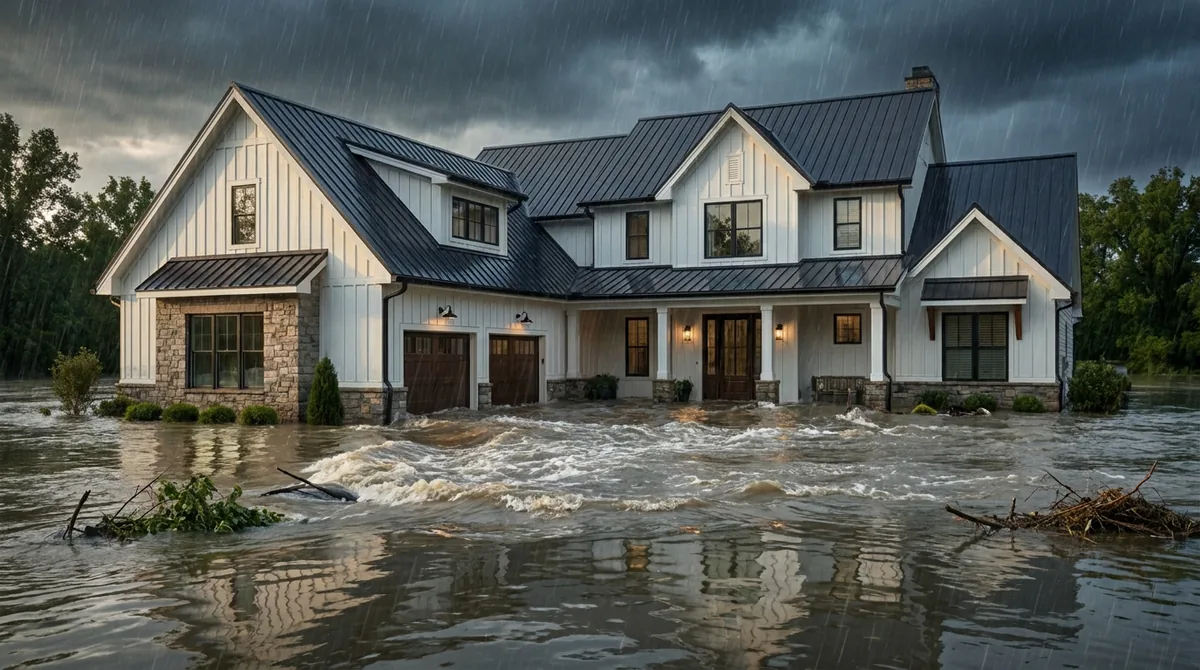
The short answer: Homeowners and wind policies both exclude flood, and in Harvey most flooded homes in Harris County were outside the 100-year floodplain, so a separate flood policy matters far beyond the mapped zones.
Hurricane Harvey is the reason we bring flood up in every conversation. The Harris County Flood Control District's final Harvey report counted 154,170 flooded structures in the county, and 68% of them sat outside the 100-year floodplain. The heaviest four-day total in the county, 47.4 inches, fell at Clear Creek and I-45, a few miles from our office.
Three things to know before you decide:
- There is usually a 30-day wait. A new NFIP policy generally takes 30 days to start. Buying when a storm is in the Gulf protects you from the next one, not this one.
- New Harris County maps are coming, but not yet. FEMA released draft maps for Harris County on February 12, 2026. They are not final and can't be used for insurance decisions yet, and no effective date has been set. Buying before a map change can matter, so it is worth asking us how your address might move.
- The NFIP runs on short extensions. Congress extended the program through December 11, 2026. If it lapses, existing policies stay in force, but new policies and renewals can't be issued until it is restored. Private flood is the backstop, which is one reason we shop both.
Start with our guide to NFIP and private flood, then read why Zone X homes still flood. When a hurricane brings both wind and water, which policy pays for which damage becomes the whole claim.
Roofs, hail and the actual cash value squeeze
The short answer: Wind and hail are most of the losses in Texas, so carriers here watch roof age closely, and an older roof can mean depreciated roof claims or fewer companies willing to quote.
TDI reported in June 2026 that Texas insurers paid $8.74 billion in homeowners losses in 2025, and that wind and hail have averaged 62% of losses since 2019. On the Gulf Coast you add hurricanes to spring hail. Beryl in July 2024 was a Category 1 storm, and still, according to the National Hurricane Center, it left about 2.7 million people in Southeast Texas without power.
That loss history is why roof questions come first on so many applications. Two policies can look identical until you read the roof line:
Replacement cost roof
Pays to put a new roof on at today's prices, minus your deductible. Carriers save this for newer roofs.
Actual cash value roof
Subtracts depreciation for age. On an older roof that can leave you paying most of a replacement yourself.
Windstorm certificate
In designated territory, re-roofs and repairs need TDI inspection for a WPI-8. Without it, TWIA eligibility can be at risk.
New roof credits
Impact-resistant shingles and recent roofs can open up carriers and discounts. Tell us when you replace yours.
If your roof is getting older, shop wider before your renewal forces the issue. Our guides on insuring a home with an older roof and replacement cost versus actual cash value go deeper.
Foundations and what a standard policy won't pay
The short answer: Standard Texas home policies usually exclude earth movement and don't pay to repair a foundation that shifts on its own, so read the foundation and water sections before you assume you're covered.
Slab-on-grade homes are the norm around Houston, and foundation repair is a familiar expense here. The Texas Department of Insurance notes that even all-risk policies usually don't pay to repair your home's foundation, and most policies exclude earthquakes and earth movement.
Where it gets more nuanced is water. Some policies respond to damage caused by a sudden plumbing leak, and the details vary a lot by company and by form. That is exactly the kind of wording we compare side by side, because two policies at similar prices can treat the same slab leak very differently.
When your renewal gets worse
The short answer: Texas law requires 60 days' notice before a homeowners non-renewal, and claims from natural causes like wind and hail don't count toward the claims limit an insurer can use to non-renew you.
Non-renewals and big renewal jumps are the calls we get most after storm seasons. Two rules help. Under Texas Insurance Code §551.105, an insurer has to mail a non-renewal notice at least 60 days before your policy ends. Under §551.107, an insurer can generally non-renew for claims only after three or more claims in three years, and claims from natural causes don't count.
In plain English: a hail claim alone shouldn't cost you your policy, and you'll have two months to replace it if the company decides to leave. Our non-renewal playbook covers what to do with those 60 days.
City guides for your part of the Gulf Coast
The short answer: The wind line, the flood history and the county split change from town to town, so our city guides go street-level where this regional page can't.
Friendswood
Two counties divided by Clear Creek, and a town that knows flooding. Read the Friendswood insurance guide and Friendswood flood guide.
League City
Fast growth between Clear Creek and Dickinson Bayou. See League City home insurance and League City flood insurance.
Pearland
New subdivisions, clay soil and a wind line that follows the Brazoria County boundary. Read Pearland home insurance.
The whole coast
What to do before and after a storm, in our Texas hurricane insurance guide.
More cities are on the way, including Clear Lake, Galveston County and Houston itself. Until then, the complete Texas home insurance guide covers the statewide rules that apply everywhere.
How we build a Gulf Coast home policy
The short answer: We set the coverage first, confirm the wind and flood answer for your exact address, then compare every carrier we shop at identical limits.
Rebuild cost
The dwelling limit should match what it costs to rebuild, not the market value or what you paid.
Your wind answer
Included on the home policy, or a separate TWIA or private wind policy? This is an address question.
Deductibles in dollars
A 2% wind deductible on a $350,000 dwelling is $7,000. We write the dollar figure down for you.
Close the flood gap
NFIP or private flood, sized to your home and started early enough to beat the waiting period.
Read the roof line
Replacement cost or actual cash value. This line can be worth more than the whole premium difference.
Then compare price
Geico, Progressive, Liberty Mutual and Safeco at the same limits, plus the wind and flood markets.
When we re-shop coverage for clients, they save on average about $500 a year. Just as often, the review turns up something more important than the money, like a dwelling limit that hasn't moved since 2019 or a roof schedule nobody explained.
The bottom line
Home insurance on the Gulf Coast isn't one product, it's a set of decisions that depend on where your house sits: which county, which side of the wind line, how close to a bayou, how old the roof is. Get those right first and the price comparison becomes simple.
We are an independent agency in Friendswood. We shop Geico, Progressive, Liberty Mutual and Safeco for the home policy, TWIA and private wind for windstorm, and NFIP and private flood for water. We aren't appointed with every carrier in Texas, and we'll say so when a market we can't access would serve you better.
Bring us your declarations pages, all of them, and we'll show you where the gaps are. (832) 703-1289.
Last reviewed by the Watson Insurance team on September 25, 2026. TWIA, NFIP and TDI figures are re-verified before every update, and this page is refreshed quarterly. Educational only, not personalized insurance advice.