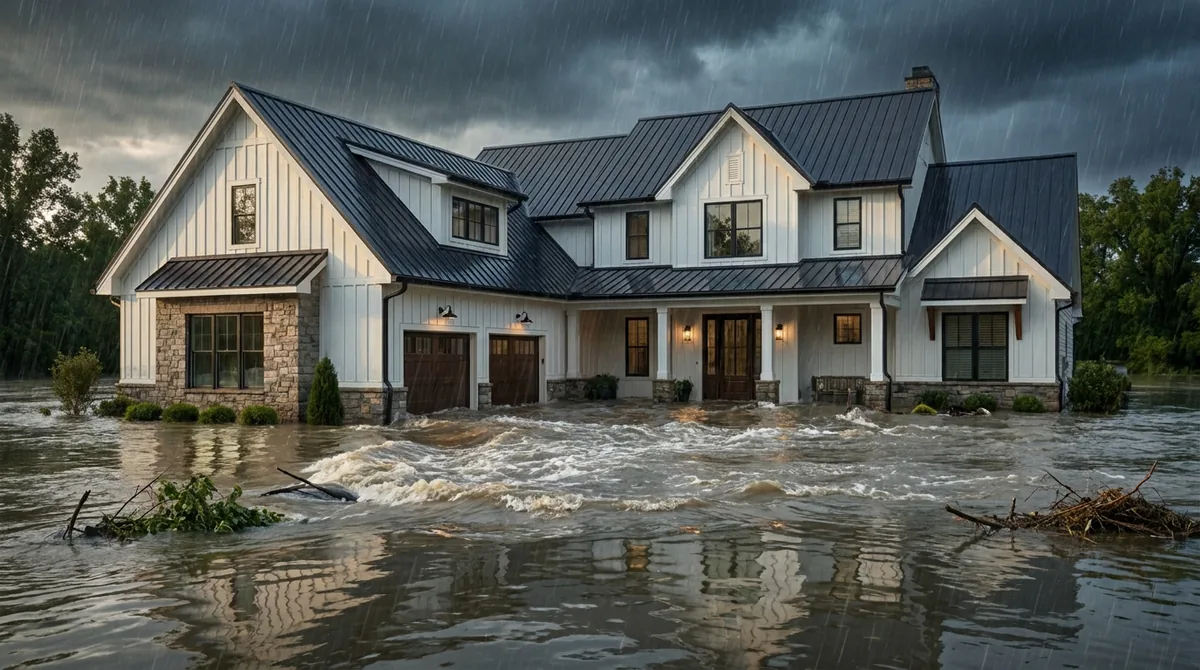
If you've lived in League City through a big storm, you probably have your own story about where the water stopped. Maybe it was the curb. Maybe it was the second step. Maybe it was the living room. Those stories are why flood insurance here deserves more than a quick yes or no based on a zone letter.
We're an independent agency in Friendswood, next door, and we write flood coverage for homes on both sides of Clear Creek. This guide uses League City's own flood data and FEMA's public claims records. If you're still sorting out the home and wind side, start with our League City home insurance guide or the Gulf Coast regional overview.
Where League City's flood water comes from
The short answer: League City drains to Clear Creek on the north, Dickinson Bayou on the southwest, Benson and Geisler bayous in the south-central part of the city, and Galveston Bay on the east, so heavy rain, creek overflow and storm surge can all reach homes here.
The City of League City describes its flood zones as following those four water sources across about 55 square miles. The city watches Clear Creek and Dickinson Bayou closely, with gauges tied into the regional flood warning system.
Harvey tested all of it at once. The National Weather Service's post-storm report recorded 52.87 inches of rain three miles south of League City and counted 24,671 damaged homes across Galveston County, naming League City, Dickinson and Friendswood among the hardest hit by Dickinson Bayou and Clear Creek flooding. In the Bay Ridge neighborhood along Gum Bayou, a resident quoted by Community Impact in 2022 put the share of flooded homes at more than 90%.
Storm surge is the other threat. During Ike in 2008, the National Hurricane Center estimated surge of 10 to 15 feet along the west side of Galveston Bay. Homes near Clear Lake and the bay shoreline face a different flood risk than homes near the inland creeks, and both belong in the conversation.
What FEMA's claims data says about League City
The short answer: In FEMA's public data, about 73% of League City's 2017 flood claims and about 76% of all its claims since 1978 were rated in moderate or low risk zones, not the high-risk floodplain.
That caveat doesn't weaken the point, it sharpens it. The map in force at the time said most of those homes were at moderate or low risk, and they flooded anyway. Maps describe a probability, not a promise, which is why our guide to flood insurance outside a high-risk zone exists.
Harvey wasn't the only event in the data. The same records show 727 League City claims tagged to Ike in 2008 and 344 tagged to Tropical Storm Allison in 2001.
The 2019 maps, and what could change next
The short answer: League City's current FEMA maps took effect August 15, 2019 and roughly tripled the homes in the 100-year floodplain, and FEMA is working on new Galveston County maps, so checking your zone now is worth the few minutes.
The city's floodplain page counts about 3,730 homes in the 100-year floodplain and about 7,378 in the 0.2% annual chance zone under the 2019 maps. Houston Chronicle reporting put the 1999 map counts at about 1,265 and 4,245.
The city also notes that FEMA is working on new flood maps for Galveston County. We don't know yet how individual addresses will change, so here's how we think about it:
- If a new map raises your risk, coverage already in place before the change can matter for your pricing. That is a reason to buy before the maps land, not after.
- If you're newly mapped into a high-risk zone, FEMA allows a 1-day waiting period instead of 30 for a policy bought within 13 months of the map revision.
- If a lender requires flood insurance after a map change, you'll get a letter. It's much better to have priced options before that letter arrives.
Our guide to Texas flood zones explains what A, AE, V and X actually mean for your policy.
Building higher: League City's 24-inch rule
The short answer: Since October 1, 2018, new and substantially improved League City homes must sit at least 24 inches above base flood elevation, which lowers flood risk and can lower NFIP premiums.
League City's development requirements set the lowest floor at least 24 inches above the highest of the base flood elevation, the nearest street crown or the highest adjacent grade, and at least 3 inches above the 500-year flood elevation. The rule also applies when damage or remodeling reaches 50% of the building's value, which is the substantial improvement threshold.
Two things follow for homeowners:
- Keep your elevation certificate. Under the NFIP's current pricing approach, a home's elevation relative to flood levels is one of the rating factors. Newer, higher homes can benefit.
- Know about Increased Cost of Compliance. If a flood leaves an insured building substantially damaged and local rules require elevating or otherwise bringing it into compliance, standard NFIP policies include up to $30,000 of ICC coverage toward that work.
What flood insurance costs in League City
The short answer: There's no honest League City average, because NFIP pricing is property-specific, but your zone, elevation, rebuild cost and the city's CRS Class 5 discount do most of the work.
Online flood cost figures for League City range widely and rarely say what house they describe. We won't add another guess. Under the NFIP's current pricing approach, premiums reflect your specific building rather than just a zone letter. The biggest drivers:
Distance to water
How close you are to Clear Creek, a bayou or the bay, and the type of flooding that reaches your lot.
Elevation and foundation
First-floor height and foundation type. League City's newer homes often rate better here.
Rebuild cost
Larger, costlier homes carry more insured value, and the premium follows.
CRS Class 5
The city says NFIP policies get 25% off inside the high-risk zone and 10% outside it.
Two more things keep costs predictable. FEMA caps most annual NFIP increases at 18% for existing policies, so a jump happens in steps. And homes outside the high-risk zone often qualify for noticeably lower rates, which makes Zone X coverage one of the better values in insurance. Our Texas flood insurance cost guide covers the statewide picture.
NFIP or private flood?
The short answer: The NFIP covers up to $250,000 for the building and $100,000 for contents, and private flood can offer higher limits or different terms, so we price both on your address.
| What to compare | NFIP | Private flood |
|---|---|---|
| Building limit | Up to $250,000 | Often higher, depending on the carrier |
| Contents limit | Up to $100,000, paid at actual cash value | Varies; some offer replacement cost on contents |
| Waiting period | Generally 30 days, with exceptions | Varies by carrier, sometimes shorter |
| CRS discount | Yes, League City's Class 5 applies | No; priced by the carrier's own model |
| Program risk | Authorized by Congress in short extensions, currently through December 11, 2026 | Not affected by NFIP lapses |
For many League City homes, the NFIP with the CRS discount is hard to beat. For higher-value homes, or when the NFIP's future is uncertain, private flood or excess flood on top of the NFIP can close the gap. Our NFIP versus private flood breakdown goes deeper on both.
The 30-day wait, and when to buy
The short answer: Buy flood insurance on a calm day, because a new NFIP policy generally takes 30 days to begin, and the exceptions are narrow.
The city reminds residents about the 30-day waiting period for a reason. Every hurricane season, someone calls us with a storm already named. We'll still write the policy, but it will protect against the next storm, not that one.
FEMA's main exceptions:
- Buying with a loan. Flood coverage required when you buy, build or refinance can start at closing.
- After a map change. A home newly mapped into a high-risk zone can get coverage with a 1-day wait within 13 months of the revision.
When a hurricane brings wind and water together, the claim becomes a question of which policy pays for which damage. Our guide to flood versus wind damage after a Texas hurricane explains how that split works.
Is the drainage work changing the risk?
The short answer: League City has invested heavily in drainage since Harvey, and it helps over time, but projects take years and don't change what your policy needs to say this season.
In May 2019, voters approved a bond that included $73 million for 21 drainage projects, according to the city's bond program page. The Bay Ridge flood reduction work along Gum Bayou has moved through several phases, with a new pump station that the city says came fully online in 2025.
More is coming. Community Impact reported in November 2025 that the city budgeted about $31 million for drainage in fiscal 2025-26, including a study of lower Clear Creek and Dickinson Bayou and a regional detention pond on Benson Bayou planned for construction in 2028.
That's real progress for long-term risk. It won't show up in your flood premium right away, and a single heavy storm can still overwhelm any system. Plan around the risk as it is today, and we'll revisit as the projects finish. Upstream, Pearland is working on the same Clear Creek watershed, as our Pearland home insurance guide explains.
The bottom line
League City's flood story is written in its own data: most of its flood claims came from homes the map considered moderate or low risk at the time. A zone letter tells you whether a lender requires flood insurance. It doesn't tell you whether water can reach your house.
The good news is that League City homeowners have tools many cities don't: a CRS Class 5 discount, newer homes built higher, and years of drainage investment. Put a policy in place on a calm day, size it to your rebuild cost and belongings, and keep your elevation certificate handy.
We write NFIP and private flood from our office in Friendswood, and we'll price both for your address. Our neighbors on the other side of the creek will recognize a lot of this from our Friendswood flood insurance guide and our Friendswood home comparison. Call (832) 703-1289.
Last reviewed by the Watson Insurance team on September 25, 2026. FEMA claims figures reflect OpenFEMA data as of June 2026; NFIP rules and the program's authorization date are re-verified before every update. Educational only, not personalized insurance advice.