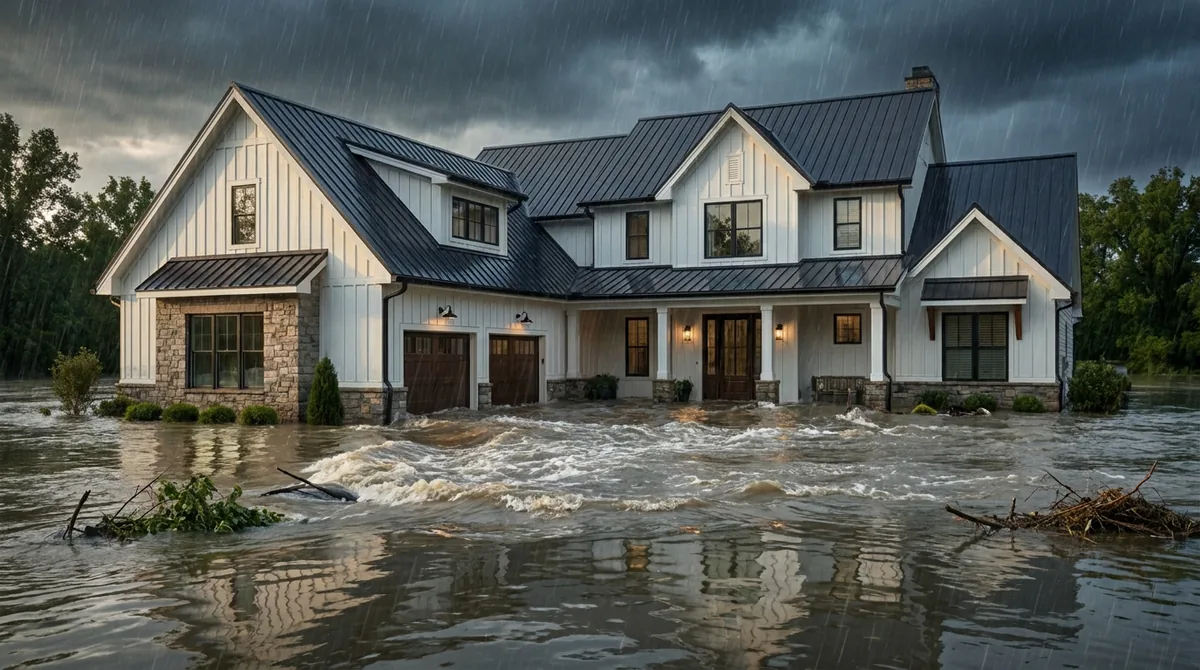
Almost every flood conversation we have starts the same way: someone standing in a wet house, holding a homeowners policy, discovering that the one thing that happened to them is the one thing it doesn't cover. We'd rather have the conversation now, on a dry day, with coffee. This guide walks through what flood insurance actually does in Texas — what the federal program pays and where it stops, what the private market adds, how the price is really built, and the two dates on this year's calendar that are worth knowing about.
Why doesn't my homeowners policy cover flood?
The short answer: Because it's excluded — every standard Texas policy, no exceptions. And Texas thought that gap was dangerous enough to write a warning label into state law.
Since 2020, Texas insurers have had to say the quiet part out loud. Texas Insurance Code §2002.103, added by S.B. 442 in the 2019 legislative session, requires an insurer issuing or renewing a property policy without flood coverage to include a conspicuous statement in the policy documents saying so. The statute even spells out that the exclusion holds "even if hurricane winds and rain caused the flood" — because that's exactly the misunderstanding that sends people into a claim expecting a check that isn't coming.
In plain English: the Legislature knew homeowners assume a hurricane policy covers hurricane water. It doesn't. And if you've never noticed that notice, that's normal — it arrives buried in a renewal packet nobody reads. Go find yours tonight. It's a two-minute check that tells you whether you have a hole in the middle of your coverage. While you're there, look for a water backup endorsement too; our sewer backup guide explains why a flood policy covers backup only in narrow cases.
The line adjusters actually draw
Forget the legal definitions for a second and think about direction. Water that comes in from above — through a roof the wind tore open, through a window it broke — is generally a homeowners or windstorm claim. Water that rises from the ground up — the bayou, the street, the surge, the runoff off your neighbor's new driveway — is a flood claim, and only a flood policy pays it.
Two near-misses worth naming, because they catch people every year. A burst supply line inside the wall is a homeowners claim, not a flood claim. And water backing up through a drain or sewer is neither — it needs its own inexpensive endorsement on the homeowners policy, which is one of the best few dollars a Houston-area household can spend.
What does an NFIP flood policy actually cover?
The short answer: Two separate coverages with two separate deductibles — the building up to $250,000 and your belongings up to $100,000, per the Texas Department of Insurance. Renters can buy the contents half on its own.
The National Flood Insurance Program is a federal program run by FEMA and sold through ordinary insurance agents and carriers, which is why a "FEMA policy" can arrive with a familiar company's name on it. The coverage itself is standardized — same form, same limits, same rules, whoever sells it.
Up to $250,000
The structure and what's attached to it: foundation, walls, electrical and plumbing, furnace, water heater, built-in appliances and permanently installed cabinets.
Up to $100,000
Furniture, clothes, electronics, and portable appliances — bought separately from the building coverage, and easy to forget until the day it matters.
Contents pay depreciated
NFIP belongings settle at actual cash value, not replacement cost. A ten-year-old sofa pays like a ten-year-old sofa. There's no full-replacement option on the federal form.
No living expenses
An NFIP policy pays nothing toward a hotel, a rental house, or extra meals while your home is unlivable. After a flood, that's often the bill that hurts first.
There's one more piece worth knowing by name: Increased Cost of Compliance. If your community declares your flooded home substantially damaged, ICC pays up to $30,000 toward bringing it into compliance — elevating it, demolishing it, or relocating it — on top of the repair payment, though the combined total still can't exceed the program's $250,000 building cap. It's the coverage that turns "rebuild exactly what flooded" into "rebuild higher."
NFIP or private flood — which one is right for my house?
The short answer: Neither wins automatically. Private flood usually wins on limits and on living expenses; the NFIP usually wins on availability and on never being dropped. Being independent means we get to run both and let your address decide.
Private flood insurance isn't new anymore, but a lot of Texans still don't know it's an option. The Congressional Research Service puts the difference in coverage terms: private carriers can compete by offering things the federal form doesn't, including living expenses while a property is repaired, basement coverage, coverage for other structures, and limits above the NFIP caps.
| What you're comparing | NFIP (federal) | Private flood market |
|---|---|---|
| Building limit | Capped at $250,000 | Higher Often well above the federal cap |
| Contents limit | Capped at $100,000 | Higher Varies by carrier |
| Contents settlement | Depreciated Actual cash value | Replacement cost often available |
| Hotel & living expenses | None | Often included |
| Waiting period | Generally 30 days | Set by the carrier — often shorter |
| Can you be non-renewed? | No Coverage continues | Yes It's a private contract |
| Accepted by your lender? | Yes | Yes If it meets the federal definition |
The lender question used to be the sticking point, and it isn't anymore. Under the Biggert-Waters Act, five federal banking regulators issued a joint final rule — effective July 1, 2019 — requiring regulated lending institutions to accept private flood policies that meet the statutory definition. If a mortgage servicer tells you they only take NFIP, that's a policy of theirs, not a rule of law, and it's worth pushing back on politely.
How much does flood insurance cost in Texas?
The short answer: Less than most people guess, and there's no statewide average that will tell you your number. Since April 2023, FEMA prices your specific building — not your flood zone. (We break the letters down in Texas flood zones explained, and what a policy actually costs in how much flood insurance costs in Texas.)
That change has a name: Risk Rating 2.0, which FEMA fully implemented on April 1, 2023. The Congressional Research Service is blunt about what it means for the old mental model — flood zones are no longer used in calculating a property's premium. Instead the rating looks at your building: distance to water, the types of flooding that reach you and how often, first-floor height, foundation type, and what it would cost to rebuild.
Two consequences follow, and they're the opposite of what most people expect. A house in an X zone can be priced higher than a neighbor in an AE zone if it sits lower and closer to the water. And a map change doesn't automatically move your rate.
What actually moves the number
- Your deductible — on both halves
Building and contents carry separate deductibles under an NFIP policy. Raising them lowers the premium, and it's a fair trade if you know what the out-of-pocket check would look like on the day.
- How high your lowest floor sits
First-floor height is one of the heaviest levers in the new rating. It's also why elevating machinery — the HVAC, the water heater, the electrical panel — can pay you back twice: less damage, and often a better rate.
- Whether you take contents coverage
Building-only is cheaper, obviously. It's also the version that leaves you replacing every stick of furniture yourself. Price both and choose on purpose.
- Your community's floodplain program
FEMA's Community Rating System gives discounts to residents of communities that go beyond the minimum floodplain standards. It's applied automatically — but it's worth knowing your town earned it for you.
- Whether you're taking over an existing policy
This is the one nobody tells buyers. If you're purchasing a home that already has a non-lapsed NFIP policy, you may be able to assume it and keep its rating path rather than starting fresh at the full risk-based rate. Ask about it before closing — once it lapses, it's gone.
One more piece of good news buried in the federal rules: for policyholders whose premiums are climbing toward a full risk-based rate, increases are limited by statute to 18% a year for primary residences. It's a glide path, not a cliff. And unlike the old system, the climbing stops once the full rate is reached.
Do I need flood insurance if I'm not in a high-risk flood zone?
The short answer: Around here, we think most households should carry it. The Texas Department of Insurance reports that on average about 40% of NFIP flood claims happen outside high-risk areas — and outside those areas is usually where coverage costs the least.
We live and work in Friendswood, so let us say this the way we'd say it across the kitchen table: "I'm not in a flood zone" is a sentence about a map, not about water. The map tells your lender when to require coverage. It has never told the rain where to go.
Texas has the receipts on this one. In the legislative record behind the 2019 flood-disclosure law, TDI reported that more than half the homes flooded during Hurricane Harvey sat outside the 100-year floodplain — and most of them carried no flood coverage at all. That's not a coastal footnote. That's the majority of a catastrophe happening to people who had been told, in effect, that they were fine.
And it isn't only a Gulf Coast story. TDI describes two large flood-prone regions in Texas: the coast, and a wide band called Flash Flood Alley running through Central and North Texas. Their summary of the state is worth reading twice — almost every major Texas city sits in an area at high risk of flooding. The Hill Country flooding of July 2025 was a hard reminder that some of the fastest, most destructive water in this state arrives hundreds of miles from the beach.

What do the new Harris County flood maps mean for me?
The short answer: Right now, nothing. They're drafts. But they're a fair preview of where the requirement line is heading, and that's genuinely useful information to have early.
In February 2026, FEMA and the Harris County Flood Control District released draft flood maps for Harris County — the first comprehensive rework in roughly two decades, built on rainfall data that accounts for how storms like Harvey actually behaved. If you've heard something about this and felt a small jolt of dread, here's the calming part, straight from the source.
The Flood Control District's MAAPnext project is unusually clear about the status: the maps are drafts shared for awareness and education, they are not final, they are not open for formal appeals, and they cannot be used for insurance or regulatory decisions. FEMA is expected to publish Preliminary Flood Insurance Rate Maps after its federal review, and only then does the formal public review and appeal period begin. Effective maps are years out, not months.
So let's retire a piece of advice you may have heard locally, because it's out of date: "buy before the new maps land and lock in a cheap rate." That was true under the old zone-based system. It isn't how the rating works now. Buying early is still the right call — just for honest reasons:
- You start the 30-day clock now instead of later
Coverage bought today is in force in a month. Coverage bought when a lender demands it is in force whenever the paperwork lands, which may be after a storm you'd rather have been covered for.
- Continuous coverage is worth something
An in-force NFIP policy can be assumed by a future buyer of your home; a lapsed one can't. That's a real, transferable asset attached to your address.
- You get to choose the market instead of being assigned one
Buy on your own schedule and we can shop NFIP against private flood properly. Buy under a closing deadline and you take whatever is fastest.
One narrow rule worth filing away in case a map does eventually move you: if a building is newly designated in a high-risk area and coverage is purchased within 13 months of that map revision, the NFIP applies a one-day waiting period instead of 30. It's a small mercy, and it has a deadline attached.
When should I buy — and what's this December deadline?
The short answer: Thirty days before you need it, which in practice means today. And yes, there's a federal date on the calendar: the NFIP's current authorization runs through December 11, 2026.
The waiting period first, because it's the one that bites people every hurricane season. An NFIP policy generally takes effect 30 days after you buy it. The rule exists precisely to stop anyone from buying once a storm has a name and a cone. Which means the correct time to make this decision is a boring Tuesday in a dry month.
The NFIP recognizes a few narrow exceptions: coverage bought in connection with making, increasing, extending, or renewing a mortgage loan; additional coverage selected on a renewal bill; a building newly designated in a high-risk area, bought within 13 months of the map revision; and property affected by flooding on burned federal land, purchased within 60 days of fire containment. Private flood policies set their own waiting periods, which are often shorter — one of several reasons we quote both.
We're not raising this to rattle you. Congress has extended the program many times, usually attached to broader funding bills, and the likeliest outcome is another extension. But "likeliest" isn't a plan, and a closing date is a real deadline. Planning around it costs you one phone call.
After a hurricane, does flood or wind pay?
The short answer: Usually both — through different policies, with different deductibles and different adjusters. Which is exactly why the documentation you gather in the first 48 hours matters so much.
On the upper Texas coast, a single storm can trigger three separate claims on one house: the homeowners policy for wind-driven rain through a damaged roof, a windstorm policy for the wind and hail damage itself, and the flood policy for everything the water did from the floor up.
That middle layer is a coastal Texas specialty. In designated catastrophe territory — the 14 first-tier coastal counties plus the part of Harris County east of Highway 146 — many standard policies exclude windstorm entirely, and wind is written separately through a private wind carrier or the Texas Windstorm Insurance Association. Around here that boundary runs close to home: Galveston County is first-tier, and the Highway 146 corridor through Seabrook and Kemah is the line itself. TWIA reports an average residential premium of about $2,541 a year as of June 30, 2026.
The critical thing to know about TWIA: it covers wind and hail only. No water damage, no storm surge, no liability. It never overlaps with flood coverage, and it never substitutes for it. When a storm brings both, our guide to wind versus flood claims explains how the damage gets divided.
| What happened | Which policy pays | Watch out for |
|---|---|---|
| Roof torn open, rain came through | Homeowners, or the windstorm policy in coastal territory | Percentage wind/hail deductible, not a flat dollar amount |
| Storm surge came into the house | Flood policy only | No flood policy means no payment — from anyone |
| Street flooded, water rose inside | Flood policy only | Separate building and contents deductibles |
| Fence blown down | Homeowners or windstorm | Flood policies generally exclude fences |
| Car flooded in the driveway | Auto — comprehensive coverage | Never a flood-policy claim, never a home claim |
| Wind and water both hit the same room | Disputed Often both, apportioned | This is where documentation decides the outcome |
That last row is the one that turns into a fight. When wind and water damage the same walls, adjusters have to apportion the loss between two carriers, and the party with better evidence tends to do better. So: photograph everything before you clean up, get the waterline height on video with something in frame for scale, keep the receipts, write down every claim number, and don't let one adjuster's verbal opinion settle a question the other policy should be answering. If you're our client, you don't do that alone — that's the part of the job we actually enjoy.
The bottom line
Flood is the biggest uncovered risk in most Texas households, and it's also one of the least expensive gaps to close — especially outside the mapped high-risk zones, where most people assume they don't need it and where about 40% of claims come from anyway. Check whether you have a policy at all. Add contents if you only have building. Get the number for both the NFIP and the private market before you decide. Start the 30-day clock now rather than in September. And if you're on the coast, know which of your three policies covers what before a storm makes it an emergency question.
We'll do all of that with you for free, in about fifteen minutes, and you'll hang up understanding your own coverage better than most people ever do. No pressure, no jargon, and no pretending an average premium tells you anything about your house.
Last reviewed by the Watson Insurance team on July 25, 2026. This guide is educational and is not personalized insurance advice — the coverage that fits your address takes a conversation. Flood programs, federal authorization dates, and Texas maps change often, and we refresh this guide quarterly.