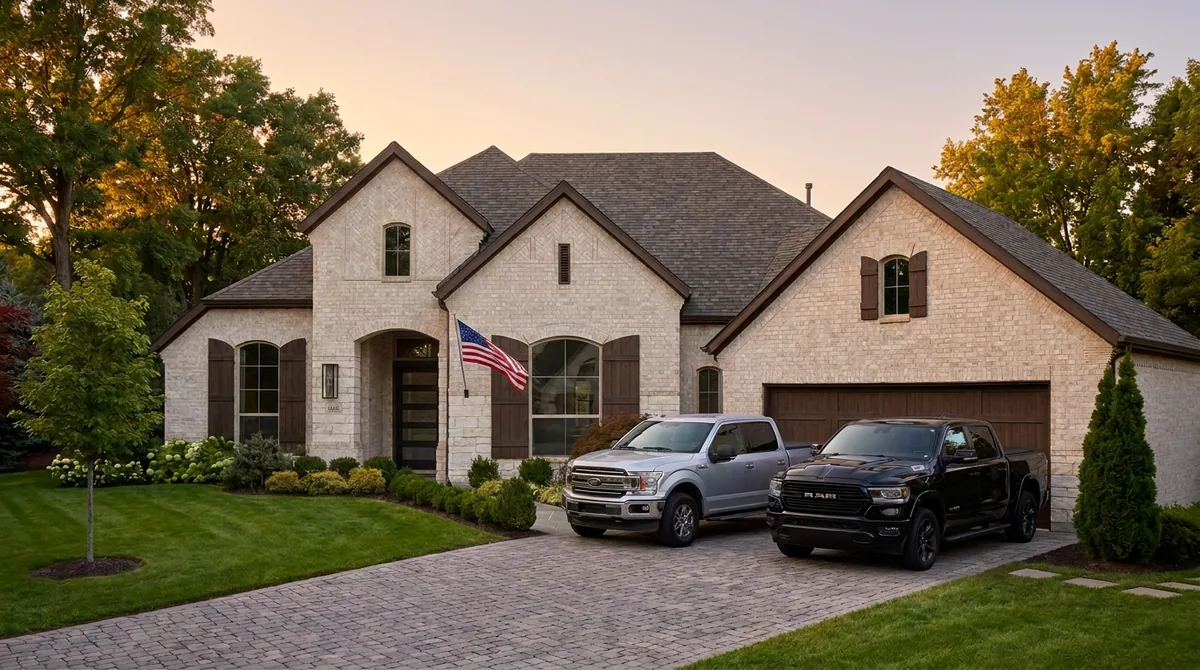
Our office is on Parkside Drive, which means the houses in this guide are the ones we drive past. (For the whole picture across home, wind, flood and auto, start with our Friendswood insurance guide.) That's the honest reason to read a local page instead of a national one: the thing that decides what you pay in Friendswood isn't a carrier's advertising budget, it's a creek.
Friendswood sits in two counties, floods from four creeks, and sits close enough to Galveston Bay that storm surge is on the city's own risk list. So "best home insurance in Friendswood" is a different question than "best home insurance in Texas" — and answering it well means talking about your address before talking about a company.
What "best home insurance in Friendswood" actually means
The short answer: The best stack, not the best single policy. Most Friendswood homes need a homeowners policy, a wind answer, and flood — and the cheapest homeowners quote can quietly be the worst of the three.
Here's the trap. Someone compares homeowners quotes online, picks the lowest, and never learns that the policy excludes windstorm, that flood was never part of the conversation, and that their dwelling limit reflects what they paid for the house rather than what it would cost to rebuild it.
Homeowners
Fire, theft, liability, burst pipes, and — depending on your address — wind and hail. That last clause is the whole game in this town.
Wind & hail
Either included on your homeowners policy or carved out and written separately through TWIA or a private wind carrier.
Flood
Never included in a homeowners policy anywhere in America. In Friendswood it is not a theoretical purchase.
Where money is lost
A claim that falls between two of these is the most expensive thing that happens to local homeowners. Nobody's shopping cart checks for it.
So the comparison worth running isn't "which carrier is cheapest." It's "which combination covers this house, at limits that match rebuild cost, with no gap where the three meet." That's the comparison we run, and it's the only version that survives a claim.
The Clear Creek problem — why your address matters more than your ZIP
The short answer: Friendswood floods from four creeks and a bay, and it has the claim history to prove it. Underwriters know this town by name.
The City of Friendswood's own flood risk page puts it plainly: Friendswood is an inland city that is nonetheless affected by storm surge from Galveston Bay and riverine flooding from four major creeks and their tributaries. Heavy rainstorms cause most of the damage, and the region's flat topography means water takes a long time to leave.
Then there's the record. The Galveston County Daily News reports that Hurricane Harvey inundated more than 3,000 homes in Friendswood and prompted more than 1,000 rescues, with Clear Creek reaching record levels. Tropical Storm Beta put water back into Clear Creek neighborhoods in 2020. This is not a town where flooding is hypothetical.
The city is actively working on it — Friendswood secured a $10 million state grant in 2026 for the Lower Clear Creek drainage project, alongside FEMA-funded lift station mitigation work tied to Harvey. That's genuinely good news for long-term risk. It does not change what your policy needs to say this year.
Which side of the creek are you on?
The short answer: In Friendswood, Clear Creek separates Harris County from Galveston County — and that county line can change which windstorm market applies to your house.
This is the most Friendswood-specific thing on this page, and almost nobody outside a local agency will tell you about it.
Per Houston Chronicle reporting on the city's post-Harvey rebuilding rules, Clear Creek marks the line between Harris and Galveston counties as it runs through Friendswood. Meanwhile, TWIA's designated catastrophe area covers all fourteen first-tier coastal counties — Galveston among them, in full — plus only the portion of Harris County east of Highway 146.
Put those two facts together. Friendswood sits west of Highway 146. So the Galveston County side of town is inside designated windstorm territory, while the Harris County side generally is not — and the boundary between them is a creek running through the middle of the city.
Practically, that can mean:
- Whether your homeowners policy is likely to exclude wind and hail, sending you to TWIA or a private wind carrier for a second policy
- Whether you're dealing with a percentage wind deductible instead of a flat dollar amount
- Whether windstorm certification becomes part of your roofing and renovation decisions
We're not going to tell you which side your house is on from a blog post — that's an address-level question, and the flood map regimes on either side of the creek have their own complicated history too. But it's the first thing we check, and it's the reason a Friendswood quote should never be run on ZIP code alone. Our Texas windstorm guide covers how the TWIA side of that works in detail.
The carriers we shop for Friendswood homes
The short answer: Geico, Progressive, Liberty Mutual and Safeco for the homeowners layer, TWIA and private wind for the windstorm layer, NFIP and private flood for water. Which one wins depends entirely on your house.
What actually separates them for a house in this town
Rather than a leaderboard — which would be dishonest, since the winner changes house to house — here's what genuinely differentiates them locally:
| What we're weighing | Why it decides the answer in Friendswood |
|---|---|
| Roof age tolerance | The sharpest differentiator here. Carriers draw the actual-cash-value line at different roof ages, and in our established neighborhoods that single rule often determines who can quote you at all. |
| Whether wind is included or excluded | Changes the entire structure of your stack — one policy or two — and depends on which side of the creek you're on. |
| Prior-claim appetite | After Harvey and Beta, plenty of Friendswood homes carry a claim history. Carriers weigh a flood claim on the property very differently from one another. |
| Replacement cost vs. ACV on the roof | Two quotes at the same premium are not the same policy if one depreciates your roof. This is where cheap quotes usually hide. |
| Financial strength & claims handling | In a town that has filed a lot of claims, how a carrier behaves after a regional catastrophe matters more than a modest premium difference. |
| Bundling with auto | Sometimes it wins. On the coastal side of town it often wins less than advertised, because the wind policy usually can't be bundled at all. |
We deliberately don't publish sample premiums on this page. There is no honest way to show what "a Friendswood home" costs — the spread between a 1970s house near the creek and a newer elevated build a mile away is enormous, and a made-up average would mislead you more than it helps. What we'll do instead is run all of them on your actual address and show you the real numbers side by side.
Roof age: the thing that decides your options here
The short answer: In Friendswood's established neighborhoods, roof age narrows the field faster than anything else — and it's the most common reason a homeowner's renewal suddenly gets worse.
Friendswood has a lot of houses built in the 1970s through 1990s, and a lot of roofs replaced after Harvey. That creates a bimodal market: homes with recent roofs are attractive to carriers, homes approaching the fifteen-year mark start seeing fewer options, actual-cash-value settlement offers, or non-renewal.
The distinction that costs people real money:
Replacement cost
Pays what it costs to put a new roof on today. What you want, and what carriers reserve for newer roofs.
Actual cash value
Pays replacement cost minus depreciation for age. On a 15-year roof that can be a fraction of the repair bill, with you covering the rest.
Two quotes at similar premiums can differ by tens of thousands of dollars at claim time on this single line. It's the first thing we read on any Friendswood declarations page, and it's why "cheapest" is such a poor way to shop here.
If your roof is getting older, the move is to shop wider, not to panic — carriers draw those lines in different places, and knowing who's flexible this season is most of the value we add. And if you're on the Galveston County side of the creek, remember that roofing work in designated territory has a windstorm certification dimension too. The Texas home insurance guide covers the roof schedules in more depth.
The flood layer isn't optional here in practice
The short answer: Being outside a high-risk zone means you aren't required to buy flood insurance. In a city that put 3,000+ homes underwater in one storm, it doesn't mean you don't need it.
Your homeowners policy excludes flood. Your wind policy, if you have one, excludes flood. Federal law requires flood coverage only for federally backed mortgages on properties in high-risk zones — which is a lending rule, not a risk assessment.
The Friendswood-specific point: a great many homes damaged in Harvey were not in a mandatory-purchase zone. The city's own flood page describes riverine flooding from four creeks plus bay surge, and the region's flat terrain means water lingers. Zone X is a map designation, not a promise.
Three things worth knowing before you decide:
- There's a waiting period. NFIP policies generally take 30 days to take effect. A flood policy bought when a storm is in the Gulf protects you against the next one.
- Pricing is no longer zone-driven. Under FEMA's current approach, premiums reflect your specific property — elevation, foundation type, distance to water, rebuild cost — not just a zone letter.
- Prior claims follow the property, not the owner. If you're buying in Friendswood, the flood history of that specific address is something we can help you check before you close.
Our Texas flood insurance guide covers NFIP versus private flood in full, and the hurricane guide covers which policy pays for what when all of this arrives at once. For the claim itself, our guide to flood versus wind damage explains how adjusters split the two.
How to actually choose — in about fifteen minutes
The short answer: Set the coverage first, then compare. Reversing that order is how people end up with a cheap policy that fails.
Fix the dwelling limit
To rebuild cost, not market value and not the purchase price. Coastal construction costs have moved a lot since 2020.
Find your wind answer
Included, or a separate TWIA or private wind policy? This depends on your address, not your ZIP.
Convert the deductible
If it's a percentage, multiply it out. A 2% wind deductible on a $400,000 home is $8,000 — before any claim money moves.
Check the roof line
Replacement cost or actual cash value? This one line can be worth more than the entire annual premium difference.
Price the whole stack
Home plus wind plus flood, at identical limits, across every carrier that can write it. Compare totals, not the one line in the advertisement.
Then look at price
Once the coverage is genuinely equivalent, the cheapest one is simply the right answer. Not before.
That's the sequence we run, and we'll run it for you whether or not you buy anything. When we re-shop coverage for clients, they save on average about $500 a year — but on a Friendswood house the review usually turns up something more valuable than the money, like a dwelling limit set in 2019 or a roof schedule nobody explained.
The bottom line
There isn't one best home insurance company in Friendswood, and any page that names one without asking for your address is guessing. What's true is narrower and more useful: the best answer in this town depends on which side of Clear Creek you're on, how old your roof is, whether the property has a claim history, and whether all three of your policies actually meet without a gap.
We shop Geico, Progressive, Liberty Mutual and Safeco for the homeowners layer, TWIA and private wind for windstorm, and NFIP and private flood for water. We're not appointed with every carrier in Texas and we won't pretend otherwise — but we'll quote all of ours at identical limits and show you the real comparison.
The last thing worth saying is the local part. Our office is at 2 Parkside Drive, Suite 109, about two minutes from most of the neighborhoods in this guide. We watched this town flood, and we've handled the claims that followed. That doesn't make our quotes cheaper. It does mean nobody has to explain to us where Clear Creek is.
Shopping nearby? See our guides to League City home insurance and Pearland home insurance, our League City flood guide, or the Greater Houston and Gulf Coast guide for the regional picture.
Bring us your declarations pages — all three of them. (832) 703-1289.
Last reviewed by the Watson Insurance team on August 24, 2026. Carrier appointments, appetite and pricing change constantly and are re-verified before every quote; this page is refreshed quarterly. Educational only — not personalized insurance advice.