Texas home insurance stopped feeling routine somewhere around 2022. Renewals jumped, roofs grew fine print, and words like percentage deductible and windstorm territory started showing up in kitchen-table conversations from Friendswood to Fort Worth. This guide is the whole picture in one place — what your policy actually does, where the traps are, what Texas law promises you, and how to pay a fair price for real protection. Coffee's optional, but recommended.
Why does Texas home insurance cost so much — and is it finally slowing down?
The short answer: Because Texas weather sends carriers bigger bills than almost anywhere in the country, and rebuilding got expensive. The average premium reached $3,291 a year in 2024, per the Texas Department of Insurance — but the pace of increases has cooled hard, from 18.7% in 2024 to 4.3% in 2025.
If your renewal letters the last few years felt like a prank, you're not imagining it. The Federal Reserve Bank of Dallas found the median Texas homeowner paid about 60% more for home insurance in 2024 than in 2019. Four things stacked up at once: hail seasons that lead the nation, hurricanes and a statewide freeze that rewrote loss models, rebuild-cost inflation on labor and materials, and pricier reinsurance — the insurance that insurance companies buy.
One more Texas-specific thing worth knowing: unlike some states, Texas allows credit-based insurance scoring on home policies. Your credit history is part of your price here, and carriers weight it differently — which is one reason the same house gets quotes hundreds of dollars apart. You can't opt out of the scoring. You can make carriers compete over it. That second part is our whole job.
What does a Texas homeowners policy actually cover?
The short answer: Six coverages doing six different jobs. Most people think of homeowners insurance as one thing that "covers the house." It's really a stack — and the gaps between the layers are where claims go wrong.
The HO-3 is the standard homeowners form in Texas and almost everywhere else. Here's what each part actually does:
Dwelling
The structure itself: walls, roof, floors, built-ins, plumbing, wiring. This is the number that should track rebuild cost — and it's the one most often set wrong.
Other Structures
Detached garage, fence, shed, workshop, and the casita out back. Usually defaults to 10% of your dwelling limit, which real Texas outbuildings routinely outgrow.
Personal Property
Everything that would fall out if you turned the house upside down. Typically 50–70% of dwelling. Jewelry, guns, and collectibles carry sub-limits and often need scheduling.
Loss of Use
Pays your living costs while the house is unlivable after a covered loss — the hotel, the rental, the extra meals. After a hurricane, this coverage carries families for months.
Personal Liability
Protects your savings when someone's injured on your property or you're responsible for damage — the dog bite, the trampoline, the guest on the wet patio. Size it to your assets.
Medical Payments
Small, no-fault medical coverage for guests hurt at your place — designed to handle the minor stuff before it ever becomes a liability claim.
What an HO-3 never covers
Every standard Texas policy excludes flood — completely, no exceptions, more on that below. Earth movement is excluded too, which in this part of Texas mostly means foundation damage from shifting expansive soil: the slow clay-driven cracking our region is famous for isn't a covered peril. Wear and tear, gradual leaks, and most mold are out. And in designated coastal territory, windstorm itself may be excluded and written separately — which deserves its own section.
How much dwelling coverage do I actually need?
The short answer: Enough to rebuild the house — not what Zillow says it would sell for. Those are different numbers, and confusing them is the most expensive mistake in this whole subject.
Market value includes the lot, the school district, the commute. Rebuild cost is lumber, labor, roofing, and permits. Sometimes rebuild cost is lower than market value; after the last few years of construction inflation, it's often higher than people assume. TDI's market data shows the average insured dwelling amount in Texas jumped from about $287,900 in 2019 to $408,500 in 2024 — that's the market repricing what it costs to put a house back.
What's this separate wind and hail deductible — and what's TWIA?
The short answer: In Texas, wind and hail claims usually run through their own deductible — a percentage of your dwelling limit, not a flat dollar amount. And close to the coast, wind is often a separate policy entirely.
Here's the math nobody does until the adjuster is in the driveway: a "2% wind/hail deductible" on a home insured for $400,000 means the first $8,000 of a hailstorm is yours. Statewide these deductibles typically run 1–2%; near the coast they reach 5%. It's the single most misunderstood number on a Texas declarations page, and it's worth choosing on purpose rather than by default.
Then there's the coastal wrinkle. Texas draws a line called designated catastrophe territory — the 14 first-tier coastal counties, plus the part of Harris County east of Highway 146. Inside it, many standard carriers exclude windstorm altogether. Wind then comes from a private wind carrier or from the Texas Windstorm Insurance Association (TWIA), the state's wind insurer of last resort. Around here, that line runs close to home: Galveston County is first-tier, and the Highway 146 corridor through Seabrook and Kemah is the boundary itself.
| Coverage | Standard HO-3 (inland) | Coastal HO-3 + TWIA |
|---|---|---|
| Fire, theft, liability | Yes | Yes Via the HO-3 |
| Wind & hail | Yes Percentage deductible | Yes Via TWIA only |
| Water damage (burst pipe) | Yes | Yes Via the HO-3 |
| Flood & storm surge | No Separate flood policy | No Separate flood policy |
| Loss of use after wind damage | Yes | Limited Check both policies |
Three TWIA facts worth carrying around: it covers wind and hail only — no water damage, no theft, no liability, which is why it always pairs with a companion policy. It requires a WPI-8 windstorm certificate for construction and improvements, so re-roofing on the coast without one can make the new roof uninsurable through TWIA. And the current news is genuinely decent: TWIA filed for no rate change on 2026 policies, and its average residential premium runs about $2,541 a year as of June 30, 2026, per TWIA. TWIA's 2026 rate adequacy analysis now finds its rates adequate by 9% on the residential side — a reversal from a year earlier — and its Board voted unanimously on August 4, 2026 to file no rate change for 2027. The dwelling cap is set annually and a change was filed in August 2026, so confirm the current figure at quote time; higher-value coastal homes layer private excess wind on top.
Does my homeowners policy cover flood?
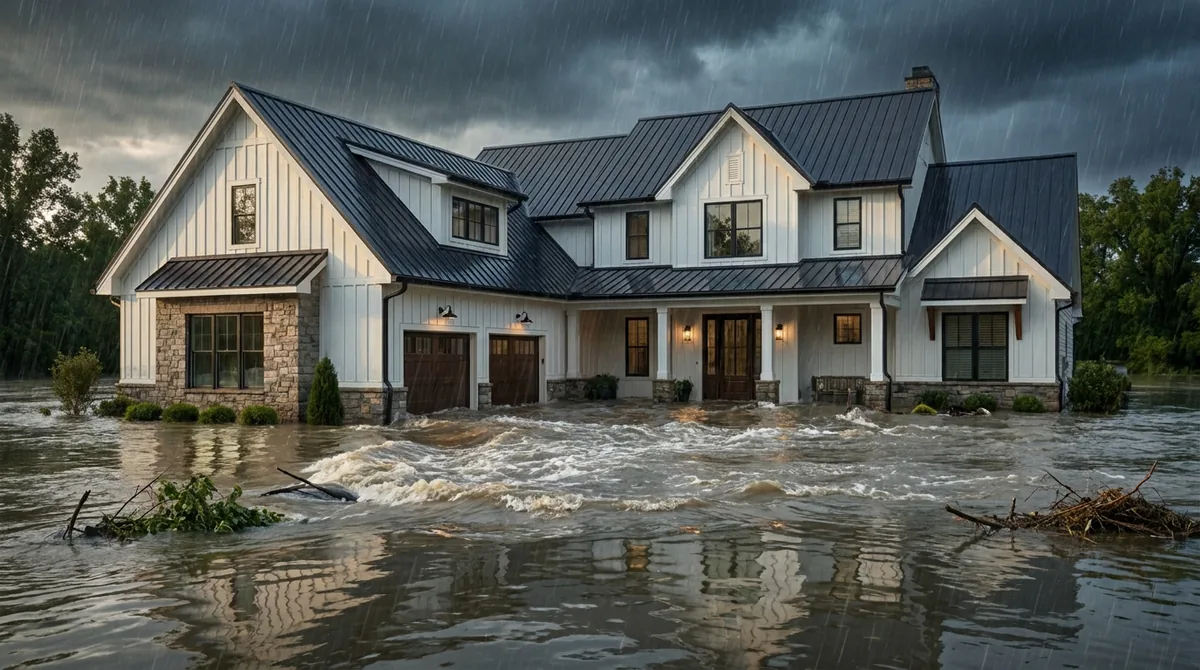
The short answer: No. Not partially, not sometimes — never. Flood is excluded from every standard Texas homeowners policy and covered only by a separate flood policy, through the National Flood Insurance Program or a private flood carrier.
We live in Friendswood — we wrote a whole guide on home insurance here specifically. Clear Creek has been in our living rooms, our neighbors' living rooms, and our claims files. So we'll say this as plainly as we can: "I'm not in a flood zone" is a sentence about a map, not about water. When Hurricane Harvey hit, roughly 7 in 10 flooded homes sat outside the mapped high-risk zone. The map describes where lenders require coverage — it doesn't describe where rain goes.
What flood coverage looks like: the NFIP caps out at $250,000 for the dwelling and $100,000 for contents — enough for many homes, not for all of them. Private flood carriers can go higher, sometimes with shorter waits and broader coverage, and for many Houston-area addresses outside high-risk zones the premium is smaller than people expect. We quote both and show you the side-by-side.
And there's a clock ticking on this one. In February 2026, FEMA released draft new flood maps for Harris County — the first comprehensive update in nearly two decades, built on post-Harvey rainfall data. Per the Harris County Flood Control District, the drafts have no regulatory effect yet and final adoption is estimated around 2028–2029, but when they land, on the order of 170,000 additional properties move into high-risk designations — where flood insurance becomes mandatory with a federally backed mortgage. Getting covered while your address still rates favorably is one of the few genuine buy-now advantages in insurance.
What about my roof?
The short answer: In the state that leads the nation in major hail events, your roof is the main character of your policy — and the fine print about how it's covered matters more than almost anything else on the page.
The distinction to find on your declarations: replacement cost versus actual cash value on the roof. Replacement cost pays what a new roof costs. Actual cash value pays what your old roof was worth — new-roof price minus years of depreciation. More and more Texas policies quietly move older roofs onto ACV schedules, which can turn a $22,000 hail claim into a check for a fraction of that, minus your percentage deductible.
Roof age also drives whether carriers will write the house at all. Many tighten up on shingle roofs past the 15-year mark — fewer markets, ACV-only offers, or higher pricing. That's not a reason to panic; it's a reason to shop wider. Different carriers draw the roof-age lines in different places, and knowing who's flexible this season is exactly the kind of thing an independent agency keeps track of so you don't have to.
Can my insurer drop me, and how much notice do I get?
The short answer: Sixty days' written notice, in plain statute: Texas Insurance Code §551.105. And claims alone generally can't be the reason unless you've had three or more non-weather claims in three years (§551.107).
Translated to human: your carrier owes you 60 days' warning before a non-renewal takes effect — enough time to shop properly rather than scramble. And Texas law draws a line most homeowners don't know exists: weather claims don't count against you the way people fear. Hail and hurricane claims — the very things this state produces — generally can't be stacked up as the reason to drop you. It takes three or more non-weather claims inside three years before claims history alone justifies a non-renewal.
If the letter comes anyway, the play is simple: don't take it personally, and don't wait. Carrier appetite shifts constantly — a company trimming its book in your county says nothing about the next carrier's interest in your house. This is the situation an independent agency is literally built for: we take one application and walk it across our markets — Geico, Progressive, Liberty Mutual, Safeco, and the coastal wind and flood markets — until the right one says yes. Sixty days is plenty when someone's shopping for you.
How do I actually lower my Texas home insurance?
The short answer: Make carriers compete, stack the honest discounts, and choose your deductibles on purpose. Never save money by shrinking the coverage that exists to rebuild your house.
The single biggest lever is the least glamorous: re-shop at renewal instead of letting the policy ride. Loyalty doesn't price well in this market — appetite and rates shift every year, and the carrier that was sharpest for your house in 2023 often isn't in 2026. When we re-shop coverage for our clients, they save on average about $500 a year — same house, same limits, different carrier doing the math.
The rest of the honest list: bundle home with auto (usually helps both sides); raise the flat all-peril deductible if — and only if — you keep that amount genuinely reachable in savings; ask about impact-resistant roofing and windstorm certification credits, plus discounts for water-leak sensors, monitored alarms, and newer roofs; and keep the policy from ever lapsing, because a gap follows you into every future quote. One add-on worth asking about is sewer and drain backup coverage, which most policies leave out unless you add it.
The bottom line
Texas home insurance got expensive because Texas weather got expensive — but the market is finally catching its breath, and a flattening market rewards the people who shop it. Set the dwelling limit to rebuild cost. Do the percentage-deductible math out loud. Close the flood gap while it's cheap and the maps are still drafts. Know your 60-day rights. And let carriers compete for your house every single year, because they will if someone asks them to.
That someone can be us. It's free, it takes about 15 minutes, and you'll leave the call understanding your own policy better than most agents do. Around here, that's just how we'd want our own neighbors treated.
Last reviewed by the Watson Insurance team on July 15, 2026. This guide is educational and is not personalized insurance advice — coverage that fits your home takes a conversation. Texas insurance law and rates change often, and we refresh this guide quarterly.