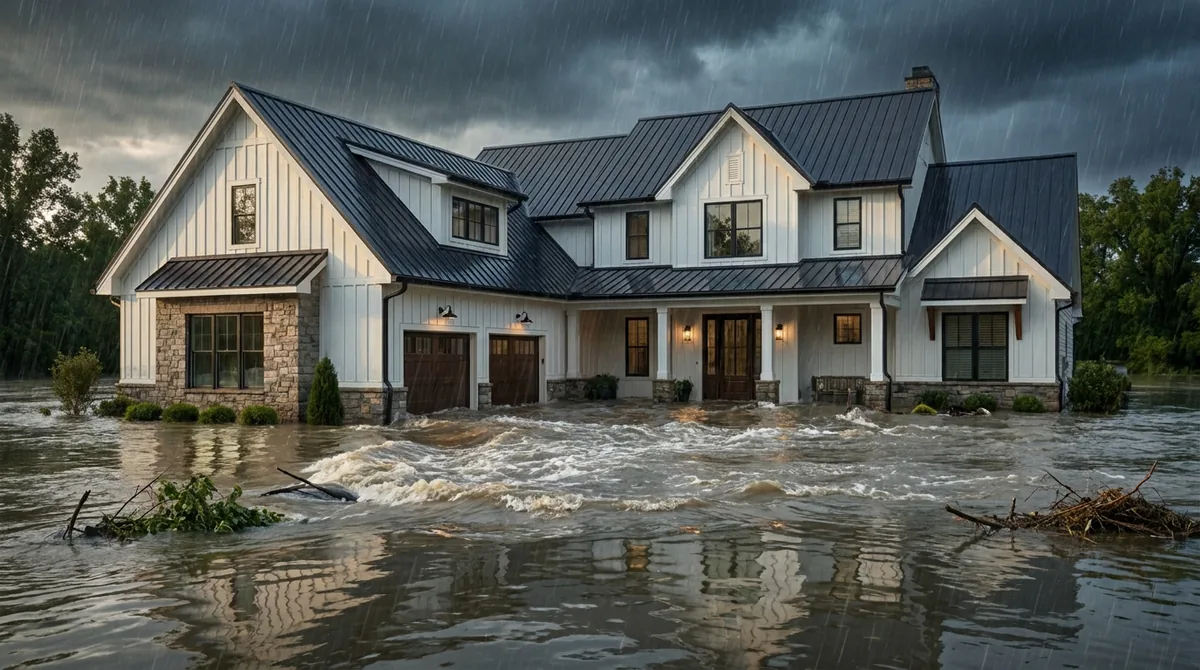
After a hurricane, most people don't think about which policy covers which damage. They think about the roof, the carpet, the smell and where the family will sleep tonight. Then the adjusters arrive, and the question of wind versus water quietly decides how much of the repair bill gets paid.
We're an independent agency in Friendswood, and we write the home, wind and flood policies that meet at that line. This guide explains how the split works in Texas, in plain English. For the bigger picture of storm season, start with our Texas hurricane insurance guide.
Why the wind-or-water question decides your claim
The short answer: Wind damage and flood damage are paid by different policies, with different deductibles, limits and deadlines, so how the damage gets classified decides who pays and how much.
On the Texas coast, a single house can carry three policies: a homeowners policy, a separate wind policy through TWIA or a private carrier, and a flood policy through the NFIP or a private flood insurer. Each one pays only for its own cause of loss.
When a storm brings both wind and water, each company is looking at the same house and asking a narrow question: how much of this damage did our covered cause produce? The answers don't always add up to the whole repair bill, and the gap is what you're trying to prevent.
How adjusters draw the line between wind and flood
The short answer: Water that rises from the ground, a creek, the bay or storm surge is flood, and damage from wind, hail or wind-driven rain is wind, with water lines and roof damage as the main evidence.
The NFIP defines flood as a general and temporary condition of partial or complete inundation of two or more acres of normally dry land, or two or more properties, from overflowing inland or tidal waters, unusual and rapid runoff of surface water, mudflow, or collapse of land along a shore. In plain English: water that covers the ground across more than just your lot.
Storm surge fits squarely inside that definition. The National Hurricane Center describes surge as an abnormal rise of water generated by a storm, over and above the normal tide. TWIA's policy, approved by the Texas Department of Insurance, excludes floods, surface water, waves, storm surge and tides, whether driven by wind or not.
| Damage | Usually paid by | What adjusters look for |
|---|---|---|
| Shingles torn off, roof decking exposed | Wind policy (homeowners, TWIA or private wind) | Missing shingles, lifted flashing, debris impact |
| Rain soaking ceilings and walls from above | Wind policy, depending on its rain wording | Staining that starts high and runs down |
| Water line on walls, soaked flooring and drywall from the bottom up | Flood policy | A consistent horizontal water line and exterior debris lines |
| Surge pushing through doors and walls | Flood policy | Tide and surge data, debris and sand inside |
| Tree through the roof | Wind policy | Wind speed at the time, tree condition |
| Flooded car | Auto policy comprehensive coverage | Not a flood policy claim at all |
Most houses aren't that tidy. A roof can lose shingles and the first floor can take on water in the same storm. That's normal, and it's why the rest of this guide exists.
Wind-driven rain: the TWIA difference
The short answer: Texas law requires TWIA dwelling policies to cover wind-driven rain damage whether or not the wind first made an opening, while many private policies only cover rain that enters through storm-created damage.
This is one of the least-known rules in Texas insurance. Texas Insurance Code §2210.208 says a TWIA policy on a dwelling must include coverage for wind-driven rain damage, "regardless of whether an opening is made by the wind," along with loss of use and consequential losses.
In plain English: if hurricane winds drive rain through a window seal or under a door on a TWIA-insured home, that rain damage can be covered even if nothing was broken first.
Private homeowners and wind policies often work differently. Many cover interior rain damage only when wind or hail first damages the roof or walls and creates an opening. It's worth reading your own policy's wording now, before a storm, rather than finding out during the claim. And remember that the NFIP does not cover wind-driven rain; that belongs to the wind side.
Our TWIA and windstorm guide covers the rest of what TWIA does and doesn't pay for.
When wind and water both hit: concurrent causes
The short answer: When covered wind and excluded flood both cause damage, Texas law generally expects the damage to be separated by cause, and some policies use wording that removes coverage entirely when flood contributes.
Lawyers call this concurrent causation. Under Texas's concurrent causes approach, when a covered cause and an excluded cause combine, the policyholder generally has to show how much of the damage the covered cause produced. A 1999 Texas appeals decision, Wallis v. USAA, describes it as presenting evidence that lets the damage be allocated to the covered peril.
Some policies go further with anti-concurrent causation language, which says the flood exclusion applies regardless of any other cause that contributed at the same time or in any order.
In JAW The Pointe v. Lexington (2015), the Texas Supreme Court applied that kind of language after Hurricane Ike. The insurer had paid for the wind damage to a Galveston apartment complex, but the court held that the policy didn't cover city-ordinance demolition and rebuilding costs triggered by the combined wind and flood damage.
What this means for you, practically:
- Evidence of the wind share matters. Photos of roof damage, wind-blown debris and interior staining that starts from above help show what wind did.
- Your policy wording matters. Whether your policy has anti-concurrent causation language is worth knowing before storm season. We can point to it.
- Flood coverage is the real protection. When both policies are in place, the argument over causes becomes a question of which policy pays, not whether anything pays.
This is general information, not legal advice. For a disputed claim, the Texas Office of Public Insurance Counsel and a Texas attorney are the right next calls.
Two claims, two deductibles
The short answer: When both wind and flood policies pay on the same storm, each applies its own deductible, and the NFIP applies separate building and contents deductibles on top.
Here's an illustration, not a quote. Say a coastal home has a TWIA policy with a 2% deductible on a $300,000 dwelling limit, and an NFIP policy with $2,000 deductibles on building and contents:
$6,000
2% of $300,000. A percentage deductible scales with your dwelling limit, so it grows as your coverage does.
$2,000
The NFIP building deductible applies to structural damage from rising water.
$2,000
The NFIP applies a separate contents deductible to damaged belongings.
$10,000
Out of pocket before both policies finish paying. Knowing this number in June beats learning it in September.
NFIP deductibles are chosen when you buy the policy, and FEMA notes building and contents deductibles apply separately. Our guide to choosing a wind deductible you can afford walks through the options. On the flood side, your zone and elevation drive the price; see flood zones explained and what flood insurance costs in Texas.
The deadlines are different for each policy
The short answer: TWIA claims must be filed within one year of the damage, NFIP proof of loss is generally due within 60 days, and private insurers follow Texas prompt-payment rules, so file every claim early.
| Step | TWIA (wind) | NFIP (flood) |
|---|---|---|
| Report the claim | Within 1 year of the date of damage (extensions possible for good cause) | Promptly; proof of loss generally within 60 days, unless FEMA extends it after a major storm |
| Decision | TWIA must accept or deny in writing within 60 days of receiving your claim or requested information | Adjusted by your NFIP insurer; advance payments may be available |
| Disagree with the amount | Request appraisal within 60 days of TWIA's notice | Appeal to FEMA within 60 days of a written denial |
| Last resort | Suit over a denial within 2 years of receiving it | Federal lawsuit within 1 year of written denial |
Sources: TWIA claims rights and responsibilities, Texas Insurance Code chapter 2210, and FEMA's NFIP Claims Handbook.
Private homeowners and wind insurers follow Texas's prompt-payment law in Insurance Code chapter 542, with extra time allowed after declared weather catastrophes. For weather-related lawsuits against private insurers, chapter 542A requires written notice at least 61 days before filing; TWIA has its own process. The NFIP also offers advance payments: FEMA says up to $5,000 without an adjuster's visit, and up to $20,000 with authorization and documentation.
What to document from day one
The short answer: Photograph everything before cleanup, mark and measure water lines, save samples and receipts, and make only temporary repairs until each adjuster has seen the damage.
Wind-versus-water questions are settled by evidence, and the best evidence disappears fast. Pulling up soaked carpet is necessary for your health, but photos and samples should come first. The Texas Department of Insurance, TWIA and FEMA all give similar advice:
Wide, then close
Photos and video of every room and every side of the house, then close-ups of each damaged item.
The water line
Photograph and measure the highest water mark inside and outside. It's the single strongest flood evidence.
The roof and ceilings
Missing shingles, exposed decking and staining that starts at the ceiling point to wind.
Samples and serial numbers
FEMA suggests keeping carpet and flooring samples and recording make, model and serial numbers of damaged appliances.
Temporary repairs only
Tarp the roof and dry what you can, and keep receipts. TWIA asks you not to start permanent repairs before talking to a claims examiner.
Don't toss it yet
TDI's advice: don't throw anything away until your adjuster says so. Items that are a health hazard can go after they're documented.
One more tip from our desk: before storm season, walk through your house with your phone and record everything. A pre-storm video makes both claims easier.
Two adjusters, or one company doing both
The short answer: Your wind and flood claims are usually adjusted separately, and when one company handles both, federal auditors have flagged a conflict of interest worth being aware of.
If your wind and flood policies are with different companies, each sends its own adjuster, and each report covers only its own cause of loss. Ask both adjusters for copies of their reports and photos, and share them with the other side.
Sometimes the same company writes your wind policy and services your NFIP flood policy. In a report published in December 2007, GAO-08-28, the Government Accountability Office found that when one insurer adjusts both claims on the same property, it has an incentive to assign more damage to the federally funded flood side, and FEMA lacked access to the wind claim data it would need to check.
That doesn't mean anyone is doing something wrong on your claim. It does mean it's reasonable to ask how the damage was split, and to see the numbers.
Big storms produce big claim volumes. After Beryl in 2024, TWIA reported more than 31,000 claims by October and more than $295 million paid by December. Patience helps, and so does a complete, well-organized file.
What to set up before the next storm
The short answer: Have both wind and flood coverage in place well before a storm forms, know each deductible in dollars, and keep your policies and a home inventory somewhere you can reach from your phone.
- Buy flood insurance on a calm day. A new NFIP policy generally takes 30 days to start. Our NFIP and private flood guide compares the options, and it applies outside high-risk zones too.
- Confirm your wind answer. In designated coastal territory, your homeowners policy may exclude wind. Our Greater Houston home insurance guide shows where that line runs.
- Know the NFIP's status. Congress extended the program through December 11, 2026. During a lapse, existing policies continue and claims are paid, but new policies and renewals pause.
- Write the deductibles down. Every percentage converted to dollars, on one page.
If you live in League City, our League City flood guide shows how most local flood claims came from homes outside the high-risk map.
The bottom line
After a Texas hurricane, wind and water are two different claims, often with two different companies, two deductibles and two sets of deadlines. The line between them is drawn from evidence: water lines, roof damage, and photos taken before anything is thrown away.
The best way to win a wind-versus-water argument is not to need one. When a home has both wind and flood coverage, the question becomes which policy pays, not whether anything does.
We're an independent agency in Friendswood. We write home, TWIA and private wind, and NFIP and private flood, and we'll review how your policies fit together before the next storm. (832) 703-1289.
Last reviewed by the Watson Insurance team on September 25, 2026. Statutes, TWIA procedures, NFIP deadlines and the NFIP's authorization date are re-verified before every update. Educational only, not personalized insurance or legal advice.