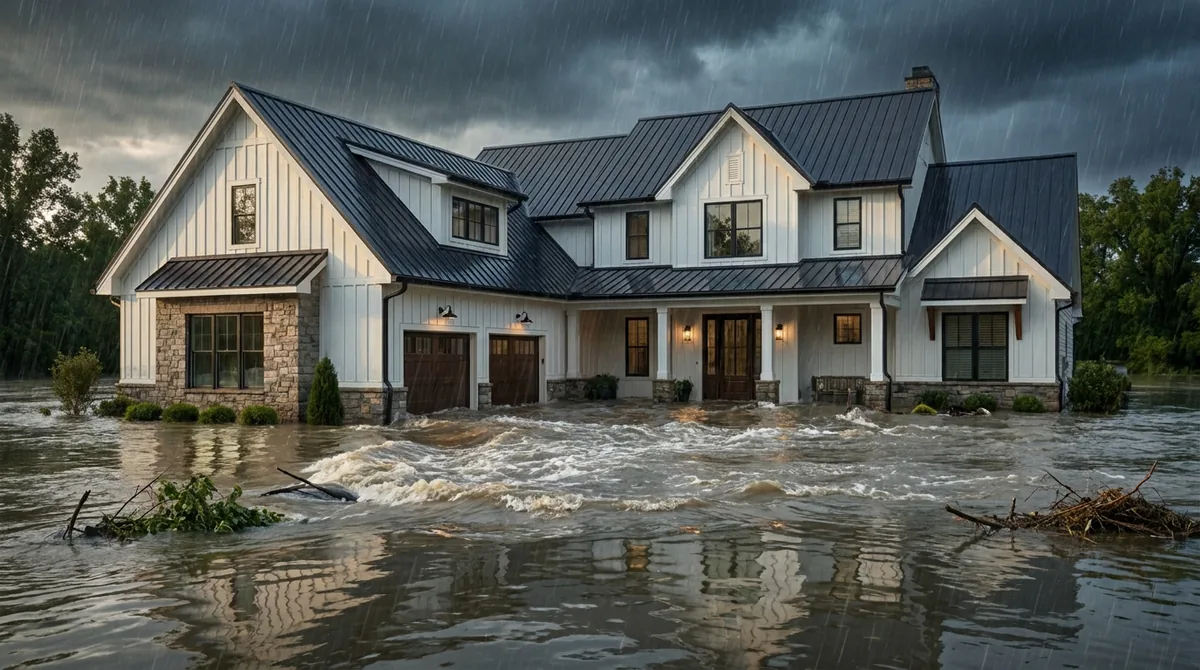
Almost every page answering this question opens with a single dollar figure. We're not going to, and the reason is the most useful thing we can tell you: flood insurance is no longer priced the way people think it is.
FEMA used to rate on a zone letter and an elevation. It now rates the building — how it's built, how high the lowest floor sits, how far it is from water, what it would cost to rebuild. Which means an "average for Texas" describes almost nobody, and two houses on the same street can price very differently for reasons a map can't show you.
What actually sets your flood premium now
The short answer: Your building, not your zone. FEMA's current approach prices each property on its own characteristics.
Per FEMA's own explanation, the previous methodology set rates using geographic zones and elevation. The current approach uses the best available flood risk data to price each property individually, weighing:
Type of flood peril
Flash flooding, waves and high water, coastal erosion. A house near a creek and a house near the bay face different perils and price differently.
The building itself
Foundation type and first-floor elevation. Slab-on-grade, pier-and-beam and elevated construction are not the same risk.
Distance to water
Elevation and distance from coasts, rivers and lakes — measured for your address, not your ZIP code.
Rebuild cost
Replacement cost value drives what a total loss would pay, so it drives the premium. Bigger, costlier homes cost more to insure.
Mitigation
Adaptations like flood vents genuinely reduce the number. This is the lever you actually control.
Levee performance
How protective infrastructure around you actually performs, rather than whether a map says it exists.
The practical consequence: "what zone am I in?" is the wrong first question about price. (It's still the right question about requirements — our guide to Texas flood zones covers what each letter means.) It's still the right question about whether your lender will require coverage — but those are two different things, and conflating them is why so many Texans are surprised by their quote in both directions.
The numbers FEMA actually publishes
The short answer: Nationally, 37% of single-family policies fall under $1,000 a year and 32% land between $1,000 and $2,000. Most people guess high.
FEMA publishes the real distribution rather than an average, which is more honest than what you'll find elsewhere. From its single-family exhibits, using policies in force as of August 31, 2023:
| Annual cost | Share of single-family policies (nationwide) |
|---|---|
| $0 – $1,000 | 37% |
| $1,000 – $2,000 | 32% |
| Above $2,000 | The remainder |
One more useful anchor from the same data: homes whose flood insurance costs less than $1,000 a year have an average replacement cost value of about $400,587. So sub-$1,000 flood coverage isn't only for small or cheap houses.
FEMA also publishes exhibits at the state, ZIP code and county level, showing the number of policies, the median risk-based cost, the median current cost, and which flood perils affect that area. If you want to see real numbers for your part of Texas rather than a national figure, that's where to look — and we're happy to walk through it with you.
Why we won't give you a "Texas average"
The short answer: Because the figures in circulation don't agree with each other, and none of them describe your house.
Search this question and you'll be told the Texas average is $779. Or $818 to $926. Or $879 to $914. Or $1,118. Those numbers come from law firms, restoration contractors and comparison sites, they disagree by more than 40%, and none of them trace back to a source we'd put Amy's licence behind.
There's a deeper problem than sourcing. Under a pricing system that rates foundation type, first-floor elevation and distance to water, an average across a state that contains both the Panhandle and Galveston Island is close to meaningless. It's an average of things that aren't alike.
The one local figure we'll point to, because it's properly attributed: a Houston Chronicle analysis of FEMA data found that as of early 2026, flood policies for single-family homes in the Houston area often ran around $1,000 a year — while ranging from several hundred dollars to more than $2,000 depending on the property's location and risk.
That range is the answer. Anyone compressing it into one number is selling you certainty they don't have.
Why your premium keeps climbing — and when it stops
The short answer: You're probably on a glide path toward your full risk-based rate. Increases are capped at 18% a year by law, and — unlike the old system — they end when you get there.
This is the part that reframes the whole conversation. FEMA reports that 38% of single-family policyholders already pay their full risk-based premium. The rest are paying less than full rate by law, and their premiums step up toward it over time. That step-up is the "glide path."
Two things are genuinely reassuring here:
- The cap. By law, rates cannot increase by more than 18% per year for most policyholders.
- The endpoint. Under the legacy approach, every NFIP policyholder faced increases every year, indefinitely. Under the current approach, annual increases stop once the full-risk rate is reached. There's a finish line now, which there wasn't before.
And the scale of change is smaller than the headlines suggest: FEMA reports that 96% of policyholders see decreases, or increases of no more than $20 a month. Decreases take effect immediately at renewal; increases phase in.
So if your flood premium has gone up three years running and you've done nothing wrong — you haven't. You're transitioning, it's capped, and it has an end.
NFIP or private flood — which is cheaper?
The short answer: Sometimes private, sometimes not, and price isn't the only axis. The coverage limits differ enough that the comparison isn't purely about premium.
The NFIP has fixed statutory coverage caps, and for higher-value homes that ceiling matters more than the premium. The private flood market can offer higher limits and, on some forms, coverage the federal policy simply doesn't include — additional living expenses being the most consequential, since an NFIP policy pays nothing toward temporary housing.
What we'd actually weigh, in order:
- Does the limit cover your rebuild cost? If NFIP's cap leaves a gap on your house, that gap matters far more than a premium difference.
- Is living expense coverage included? Six months of rent after a flood is a large number that NFIP won't help with.
- How stable is the market? NFIP won't decide Texas is unattractive. Private carriers can and do adjust appetite.
- Then price. Once one and two are equivalent, cheaper is simply better.
Our Texas flood insurance guide runs that comparison in full. The point for this page is narrower: if you've only been quoted one of the two, you haven't actually shopped flood insurance.
The levers that actually lower a flood premium
The short answer: Elevation documentation, deductible, mitigation, and your community's CRS rating. These are real, and most people use none of them.
Community Rating System
CRS discounts run 5% to 45% and apply uniformly to policies throughout a participating community — regardless of whether your structure is in a high-risk zone. Worth knowing what your city's classification is.
Elevation documentation
First-floor elevation is a major rating variable. If FEMA's estimate for your property is wrong, documenting the real elevation can move the number meaningfully.
Your deductible
Same trade as any policy — a higher deductible lowers premium. Only go as high as you could genuinely cover after a flood, when everything else is also costing money.
Mitigation
Flood vents and elevating mechanical equipment are explicitly part of how the property is rated. These reduce real risk and real premium at the same time.
The CRS one is the most overlooked, because it's community-level rather than something you buy. It's also the clearest argument for the drainage and floodplain work local governments do — that work can show up on your renewal.
Getting a number that's actually about your house
The short answer: A quote takes minutes and is free. Given how property-specific the pricing is now, it's the only figure worth acting on.
What we need to price it properly: the address, the year built, foundation type, square footage, number of floors, and whether the property has prior flood claims. If you have an elevation certificate, bring it — it's often the difference between an estimated elevation and a documented one.
Two timing points that cost people real money:
- The 30-day wait. NFIP policies generally take 30 days to take effect. Buying during hurricane season protects you against the next storm, not the one being forecast.
- Timing matters more than people think. Coverage decisions belong in spring — see our hurricane preparedness guide.
- Prior claims follow the property. If you're buying a home in a flood-prone part of Texas, its NFIP claim history attaches to the house, not the seller. Check before you close, not after.
And the thing worth weighing against any premium: your homeowners policy covers none of this. Not one dollar of flood damage, regardless of what caused the water. The question isn't really whether flood insurance is expensive — it's whether it's cheaper than the loss.
The bottom line
Flood insurance in Texas costs what your specific building costs to insure, and that's not evasion — it's how FEMA prices it now. Foundation type, first-floor elevation, distance to water and rebuild cost do more work than the zone letter on a map.
What's broadly true: most single-family policies nationally land under $2,000 a year, with 37% under $1,000. If yours is climbing, you're on a capped glide path with an actual endpoint. CRS discounts can take 5% to 45% off regardless of your zone. And there's a 30-day wait, so this is a decision to make in the spring.
We're an independent agency in Friendswood — a town where more than 3,000 homes flooded in a single storm — and we shop both NFIP and the private flood market. We'll price your address, tell you where your elevation data may be costing you, and be honest if the coverage you have is already the right answer.
Bring us the address. (832) 703-1289.
Last reviewed by the Watson Insurance team on August 24, 2026. FEMA pricing data, CRS classifications and NFIP rules change; we refresh this guide quarterly. Educational only — not personalized insurance advice.