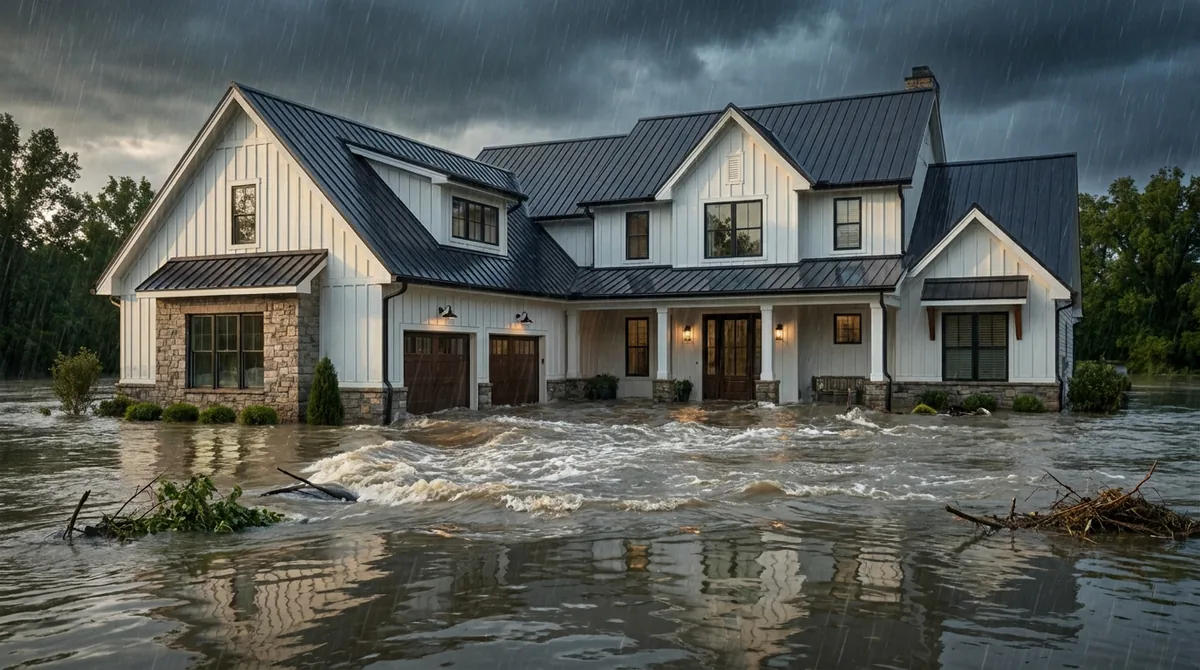
The water is finally going down. The carpet squishes, the drywall has a line across it, and somewhere in a soggy box is your flood policy.
Take a breath. A flood claim has a few firm deadlines, and it goes better in order. The National Weather Service measured 56 inches of Harvey rain at Friendswood, so Texas knows floods. This guide walks through an NFIP claim step by step. For buying advice, see our Texas flood insurance guide.
How do you start an NFIP flood claim?
The short answer: Report the flood to your insurance company or agent as soon as it's safe, in writing, with your policy number, and know that a 60-day proof of loss clock starts on the day of the flood.
Private insurance companies service most NFIP policies, so your claim goes to the company on your declarations page, not to FEMA. FEMA's NFIP Claims Handbook (August 2024) says to file your notice of loss with your agent or insurer promptly, and that every flood policy form requires prompt written notice.
- Can't find your insurer? FEMA's claim flyer gives the NFIP's FMIX line, 877-336-2627. TDI's Help Line, 800-252-3439, can also help you find a flood company's number, per its July 16, 2026 flood tips.
- Write down the claim number and everyone you talk to. If we wrote your policy, call us too.
How should you document flood damage?
The short answer: Photograph and video everything before cleanup, including the water line inside and out, keep samples of flooring and fabrics, and record make, model and serial numbers of appliances and electronics.
FEMA's claim flyer and handbook give the same list:
- The water line. Photograph floodwater lines on inside and outside walls.
- Every room, then every item. Wide shots, then close-ups, plus any receipts.
- Serial numbers. Make, model and serial number for appliances and electronics.
- Samples. Keep a piece of carpet, flooring or curtain for the adjuster.
- Health hazards can go once photographed, FEMA says.
Dry the house out as fast as you safely can. The NFIP Dwelling Form (44 CFR Part 61, Appendix A(1)) excludes mold damage from conditions within your control, including failing to inspect and maintain the property after a flood recedes.
Bought sandbags or moved belongings before the water came? The form pays up to $1,000 for each, so keep those receipts.
What happens when the adjuster comes, and can you get an advance?
The short answer: An adjuster inspects and writes a line-by-line estimate for your insurer, and after a major flood your insurer may offer an advance of up to $5,000 without a visit, or up to $20,000 with FEMA's authorization and documentation.
FEMA's flyer says an inspection should happen within a few days of your report.
- Check credentials. Ask to see the adjuster's Flood Control Number card, with a current date and photo ID. FEMA says adjusters never ask for money, collect your deductible or charge fees.
- Read the estimate room by room against your photos and bids.
Advance payments. During a major flood event, FEMA's flyer says, insurers may offer up to $5,000 without an adjuster's visit, documentation or FEMA's authorization, and up to $20,000 with FEMA's authorization and proper documentation. The advance comes off your final payment, and the handbook adds that your mortgage company must sign building checks, advances included.
What do NFIP building and contents coverage pay?
The short answer: Building coverage pays for the structure and its built-in systems, contents coverage pays for belongings at actual cash value, each with its own deductible, and neither pays for a hotel.
The NFIP sells two coverages, and the Dwelling Form applies a separate deductible to each in every flood.
| Question | Building coverage | Contents coverage |
|---|---|---|
| What it pays for | The structure: foundation, electrical and plumbing, furnace and water heater, built-in appliances, permanently installed carpet and cabinets | Your belongings, such as furniture, clothing and electronics |
| Most it pays | $250,000 on a home | $100,000 |
| How it settles | Replacement cost if it's your principal residence, a single-family home, insured to at least 80% of replacement cost or the program maximum; otherwise usually actual cash value | Actual cash value: replacement cost minus depreciation |
| Special limits | Appliances, carpet and carpet pad settle at actual cash value | $2,500 per loss for valuables such as jewelry, furs and artwork |
Sources: the NFIP Dwelling Form and FEMA's coverage page. The NFIP doesn't pay living expenses, cars, money, or property outside the building such as fences, decks and pools. A flooded car is a comprehensive claim on your auto policy, TDI says.
What does flood insurance cover in a basement or under an elevated home?
The short answer: Very little: in a basement, or in an enclosure below the lowest floor of an elevated newer home in a high-risk zone, the NFIP covers only a short list of equipment plus clean-up.
Few Texas homes have true basements, but the Dwelling Form calls a basement any area, "including any sunken room or sunken portion of a room," with its floor below ground level on all sides.
The same limits apply below the lowest elevated floor of an elevated post-FIRM building in zones such as AE or VE, the ground-level enclosures common on the coast. Our flood zones guide explains the letters. In those areas the form covers only:
- Building items, installed and connected: central air, furnaces, water heaters, electrical boxes, sump pumps, attached stairs, foundations and unfinished basement drywall, among a few others.
- Contents items: window or portable air conditioners, washers and dryers, and food freezers and the food in them.
- Clean-up.
Finished walls, floors and furniture down there aren't on the list. Drain backup is a separate question; see our sewer backup guide.
When is the proof of loss due, and what goes in it?
The short answer: The NFIP Dwelling Form says to send a signed, sworn proof of loss within 60 days after the loss, using your own judgment on the amount, even if your adjuster never hands you the form.
The proof of loss is your sworn statement of what you're claiming. The form lists what it must include, such as the date and time of loss and an inventory of damaged personal property. The handbook says to send it with your contractor's detailed estimate.
- It's your number. The form says you must use your own judgment about the amount and justify it.
- The adjuster's help is a courtesy. Many adjusters prepare a proof of loss for you to sign, but the form says the 60 days still apply if they don't.
- Extensions aren't automatic. Your insurer can ask FEMA for more time, the handbook says, but it's not assured. After Harvey, FEMA extended it from 60 days to 365 days after the date of loss, then said in an August 24, 2018 release it would not extend it further.
Once a proof of loss is in, the form says the loss is payable 60 days after your insurer receives it, once the amount is agreed or settled by appraisal or a court.
What is ICC, and when does it pay?
The short answer: Increased Cost of Compliance pays up to $30,000, with no deductible, to elevate, floodproof, relocate or demolish a home your community declares substantially damaged by flood.
After a bad flood, your city or county may declare your home substantially damaged, which the Dwelling Form describes as repairs costing at least 50% of the building's market value. Local rules can then require you to rebuild higher.
ICC pays toward that on top of the repair claim, though building and ICC together can't exceed the program maximum. It can also apply to repeat losses where your community has a repetitive loss rule.
FEMA's August 2024 handbook says ICC has its own proof of loss, due 60 days after the community's letter, and allows six years from the flood to finish the work. The policy text says two years; FEMA's bulletin W-15038 (August 10, 2015) extended it. Got a substantial damage letter? Call your adjuster and us right away.
What if you disagree with your flood claim?
The short answer: Send supporting documents to your adjuster first; you can appeal a written denial to FEMA within 60 days, any federal lawsuit must start within one year of that denial, and the appeal doesn't pause that year.
- Supplement first. Send missing items, photos and bids to your adjuster for a revised estimate.
- Appraisal, for amounts only. The Dwelling Form allows appraisal when you and the insurer disagree on the value of damaged property. Each side pays its own appraiser.
- FEMA appeal. Under 44 CFR 62.20, you appeal in writing within 60 days of the insurer's written denial of all or part of the claim. FEMA decides within 90 days of having everything it needs, and the handbook says it can't expand coverage or waive exclusions.
- Lawsuit. The form says suit must start within one year of the written denial, in the U.S. District Court where the property is.
How do private flood and coastal wind claims fit in?
The short answer: A private flood claim follows the deadlines and terms in that policy and Texas claim law, and on the coast a hurricane can mean a separate wind claim with its own adjuster, deductible and clock.
Private flood. Read your policy's conditions section for its notice and proof of loss rules; they may differ from the NFIP's. Texas's prompt-payment rules give most licensed insurers 15 days to acknowledge a claim, though surplus lines insurers follow different timelines, per the state's Office of Public Insurance Counsel. OPIC says to ask about every deadline and note it.
Coastal wind. If a hurricane brought surge and wind, you'll likely file two claims: flood, plus wind with TWIA, a private wind carrier or your homeowners policy. Our flood vs. wind damage guide covers how adjusters split the damage and TWIA's deadlines; see also our roof claim and hurricane guides.
The bottom line
Report fast, photograph before you clean, and put the 60-day proof of loss date on your calendar the first night.
We're an independent agency in Friendswood. Our public carrier lineup is Geico, Progressive, Liberty Mutual and Safeco, plus TWIA or private wind and NFIP or private flood. We re-confirm which carriers can write your policy before every quote, and we are not appointed with every carrier in Texas. Neighbors can read our Friendswood flood guide, our flood insurance page, or start a quote. Call (832) 703-1289.
Last reviewed by the Watson Insurance team on November 11, 2026. Rules are from the NFIP Dwelling Form, 44 CFR 62.20, FEMA's Claims Handbook and claim flyer, and TDI and OPIC pages viewed November 11, 2026. Educational only, not personalized insurance advice.