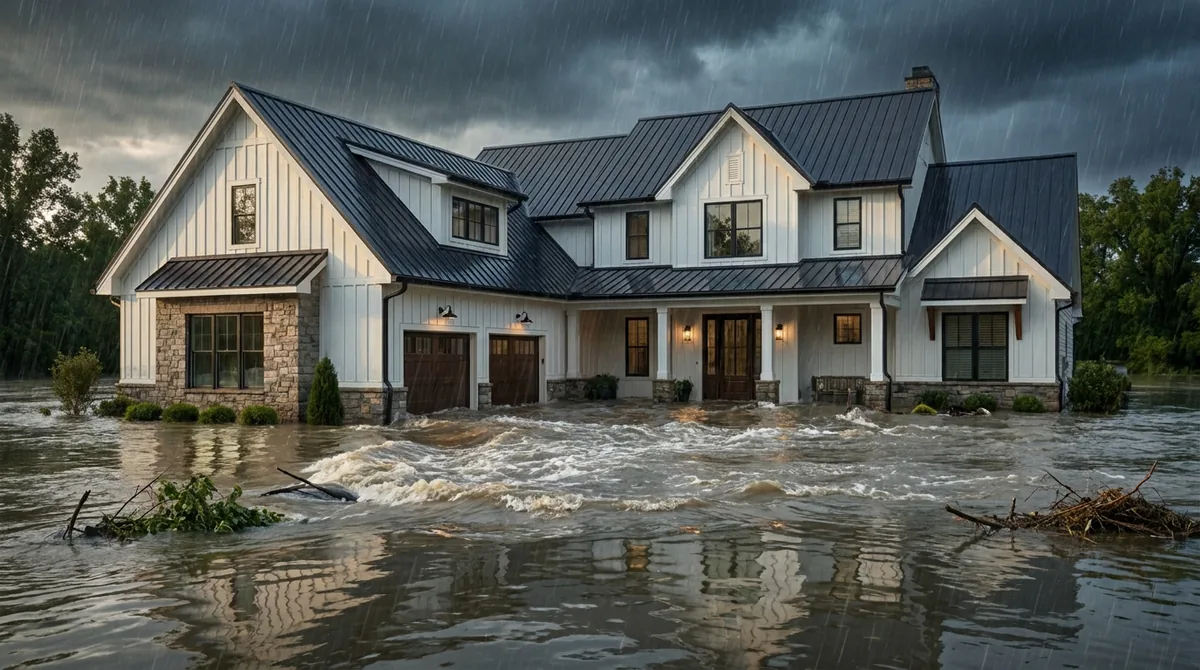
You've watched the bayou on the news, and your house was fine. Then a spring storm parked over your neighborhood, the street filled curb to curb, and the water started up the driveway. In Houston, that second story is the one people don't plan for.
We're an independent agency in Friendswood, just south of the city, and we write flood coverage for Houston homes and apartments. Our Houston home insurance comparison already covers Harvey by bayou, the Chapter 19 elevation rule and the draft maps. This page goes further on water: the storms after Allison, how street flooding works, the tools Harris County gives you for free, and how to buy before the map changes.
Houston floods without a hurricane: FEMA's claims beyond Harvey
The short answer: FEMA's public records show tens of thousands of City of Houston flood claims from storms other than Harvey, and in the two most recent big events most claims came from homes rated in moderate or low risk zones.
Harvey dominates the conversation, and our home page covers its 2017 numbers. But the city's flood history is a series of storms, some of them not even tropical. Here's what FEMA's own records show for four of them.
| Year and storm | Claims that year | Claims tied to the storm | Rated X, B or C (share of year) |
|---|---|---|---|
| 2001, Tropical Storm Allison | 12,133 | 11,842 dated June 2001 | 5,889 (about 49%) |
| 2016, Tax Day floods | 3,761 | 3,326 dated April 17 to 20 | 1,196 (about 32%) |
| 2019, Tropical Storm Imelda | 2,965 | 2,495 tagged Imelda | 1,761 (about 59%) |
| 2024, Hurricane Beryl | 1,023 | 788 tagged Beryl | 583 (about 57%) |
Look at the right-hand column. In 2019 and 2024, most Houston claims came from addresses the map rated as moderate or low risk. For most of the city, Imelda and Beryl were rain events, and rain doesn't check the map first.
That pattern is why our guide to buying flood coverage in Zone X exists, and why a dry Harvey doesn't settle the question.
Street flooding, sheet flow and bayou overflow
The short answer: Houston homes flood two ways, from bayous and creeks leaving their banks and from rain that overwhelms street drainage, and a flood policy can cover both while a homeowners policy covers neither.
The Harris County Flood Control District explains the street side plainly. Rain normally drains through storm sewers or roadside ditches to a bayou. When those fill, "the street itself will hold the water" until there's room to drain. When intense rain overwhelms local drainage, flooding can also come from ponding or overland sheet flow.
That's by design. The City of Houston's stormwater design chapter in its Infrastructure Design Manual sizes storm sewers in newly developed areas for at minimum a 2-year rainfall event. Bigger storms, up to the 100-year event, are expected to move overland. In plain English: the pipes handle ordinary rain, and in a big storm the street becomes part of the drainage system.
Two practical points follow:
- Drainage responsibility is split. HCFCD notes it doesn't have sole jurisdiction over drainage. City storm sewers are the city's job; bayous and major channels belong to the district.
- Distance from a bayou isn't the whole story. A home blocks from any channel can still take water from the street. Nationally, HCFCD's FAQ notes, about one-third of flood loss claims come from outside the mapped 100-year floodplain.
Our explainer on what each flood zone letter means covers how the maps handle this, and where they don't.
Houston flood tools worth bookmarking
The short answer: Harris County and FEMA publish free tools that show mapped floodplains, live bayou levels and the draft maps, and each one answers a different question, so it helps to know which tool to open.
Flood Education Mapping Tool
HCFCD's FEMT shows FEMA floodplains around your address. HCFCD says it is not the effective FIRM, so use FEMA's Map Service Center for official purposes.
FEMA Map Service Center
The MSC holds the effective flood map that lenders and the NFIP use, and lets you print a FIRMette for your lot.
Flood Warning System
The Harris County Flood Warning System shows rain totals and bayou levels from county gauges, with live inundation mapping. HCFCD says it isn't a warning or evacuation service.
MAAPnext draft maps
The MAAPnext viewer shows FEMA's February 2026 draft maps. They're informational only and can't be used for insurance yet.
One more source sits on your closing table: the seller's disclosure and any elevation certificate. Ask for both. The Houston Public Works floodplain office requires elevation certificates at several stages when it permits floodplain construction, so newer and rebuilt homes often have one.
Draft maps now, final maps around 2028: why the window matters
The short answer: Final Harris County maps aren't expected until about 2028, and because Risk Rating 2.0 ended grandfathering, the advantage of buying now is the 18% cap on increases and protection during the years in between, not locking in an old zone.
FEMA released draft maps on February 12, 2026. Community Impact reported the next day that final approval isn't expected until about November 2028. Some older advice says the remap lands this year. It doesn't.
The rules for map changes have also changed. Before October 2021, "grandfathering" let a continuously insured home keep the rating of its older, lower-risk zone after a remap. FEMA's December 2021 agent guidance says that under Risk Rating 2.0, all policies formerly eligible for grandfathering transition to their full-risk premium, with increases kept within the 18% annual cap set by Congress.
So what still makes the next two years a buying window?
- The 18% cap protects policies already in force. FEMA caps most annual NFIP increases at 18%. A brand-new policy starts at its full-risk price.
- A Newly Mapped discount exists. FEMA's Newly Mapped discount applies when a home moves from a moderate or low risk zone into a high-risk zone and the policy is bought within 12 months of the new map. It takes 70% off the premium on the first $35,000 of building and $10,000 of contents coverage, then rises no more than 18% a year.
- A shorter wait after a remap. A home newly mapped into a high-risk zone can get NFIP coverage with a 1-day wait within 13 months of the revision.
- The storms won't wait for the maps. None of Allison, Tax Day, Imelda or Beryl waited for a new map. A policy already in force covers the next storm.
FEMA's September 2023 map change fact sheet adds a calming note: a zone change won't immediately change your rate, because zones are no longer directly used as rating variables. What a new map does change is whether your lender requires flood insurance.
Houston's CRS Class 5 discount, and what drives the price
The short answer: City records list Houston as a CRS Class 5 community, worth 25% off every NFIP policy in the city, while elevation, distance to water and rebuild cost set the rest of the premium.
A June 2024 City of Houston presentation to a City Council committee says the city earned 3,004 credit points in its 2020 CRS verification, and program prerequisites held it to Class 5. The Texas Water Development Board's NFIP participation data also lists Houston as Class 5.
FEMA's CRS discount guide sets Class 5 at 25%, and under current NFIP pricing that discount applies to every policy in a participating community, inside or outside the high-risk zone. It doesn't apply to private flood, and it only applies inside city limits.
The rest of the premium is property-specific. FEMA weighs flood frequency and type, distance to water, first-floor elevation and rebuild cost. We don't publish a Houston average, because one number can't describe a slab in Meyerland and a raised home in the Heights. Our breakdown of Texas flood premiums explains the moving parts.
Chapter 19 when you repair, remodel or rebuild
The short answer: Inside Houston's high-risk floodplain, repairs or improvements costing 50% or more of the building's market value trigger Chapter 19 compliance for the whole structure, so permits and paperwork matter before work starts.
Houston Public Works' permitting guidance quotes Chapter 19's definition: a substantial improvement is any reconstruction, rehabilitation, addition or other improvement costing 50% or more of the structure's market value before the work begins. In Zones A, AO and AE, crossing that line means the entire structure must be brought into compliance, not just the new work.
In plain English: after a flood, the size of the repair bill can decide whether you're fixing drywall or raising a house.
- Call before you tear out. When Houston eased post-storm permitting in May 2019, Community Impact reported that homes inside floodplains still had to contact the Floodplain Management Office before repairs.
- Document the cost. The city asks for an itemized estimate from an engineer or architect, a notarized estimate with the appraisal district summary, or a licensed appraisal.
- Know about ICC. Standard NFIP policies include up to $30,000 of Increased Cost of Compliance coverage toward elevating or otherwise complying after a substantially damaged flood loss.
Clear Lake homes follow the same city rules near the bay, as our Clear Lake homeowners guide explains.
Renters and condo owners: contents-only flood
The short answer: Most Houston households rent, and a landlord's policy never covers a tenant's belongings, so contents-only flood coverage through the NFIP or a private carrier is how renters protect what they own.
The Census Bureau's QuickFacts puts Houston's owner-occupied rate at 42.1% (2020 to 2024), which means about 58% of occupied homes are rented. That's a lot of furniture, electronics and clothing sitting on ground floors.
FEMA's renters flood brochure is direct: your landlord's insurance won't cover your belongings, and a standard renters policy typically doesn't cover flood. NFIP contents coverage reaches up to $100,000 for tenant-owned property above the lowest elevated floor. Below it, or in a basement, coverage is limited to a washer, dryer, freezer and the food in it.
Condo owners have a middle layer. The association's master flood policy insures the building, and your unit's contents and improvements may need their own coverage. Start with our renters insurance or condo insurance pages, then ask us to add flood.
NFIP limits, private flood and excess flood
The short answer: The NFIP tops out at $250,000 for the building and $100,000 for contents with a 30-day wait on most new policies, so higher-value Houston homes often add excess flood or price a private policy instead.
| What to compare | NFIP | Private flood | Excess flood |
|---|---|---|---|
| Building limit | Up to $250,000 | Often higher, by carrier | Sits above the NFIP limit |
| Contents | Up to $100,000 | Varies; some pay replacement cost | Can add contents above $100,000 |
| Living expenses | Not covered | Included by some carriers | Varies by carrier |
| CRS discount | Yes, 25% in Houston | No | No |
| Program status | Authorized through December 11, 2026 | Not tied to Congress | Not tied to Congress |
On the 30-day wait, FEMA's main exceptions are coverage required at a loan closing, which can start at closing, and the 1-day wait after a new map. Congress extended the NFIP through December 11, 2026, NAHB reported in September 2026. During a lapse, existing policies keep paying claims, but new policies and renewals pause.
If your rebuild cost is above $250,000, an NFIP policy alone leaves a gap. We size coverage to rebuild cost, not market value. Our side-by-side of federal and private flood covers the trade-offs, and you can start a quote on our flood insurance page.
Two seams to close while you're at it. Wind damage belongs to your homeowners policy, as our guide to splitting flood and wind claims explains. And water pushed up through a drain may need a separate endorsement, covered in our sewer backup guide.
The bottom line
Houston's flood record is longer than one hurricane. FEMA's own data shows big claim years from a tropical storm, a spring storm, another tropical storm and a hurricane, and in the two most recent, most claims came from moderate or low risk zones.
The years before the final maps are a good time to act, for current reasons: the 18% cap on policies already in force, the 30-day wait, and the plain fact that storms don't wait for paperwork. Houston's CRS Class 5 discount helps, and renters and higher-value homes have real options beyond a basic policy.
We price NFIP, private and excess flood for Houston addresses from our office in Friendswood. South of the city, see our Pearland flood claims analysis and our League City flood page, and for the whole region, our Greater Houston and Gulf Coast overview. Call (832) 703-1289.
Last reviewed by the Watson Insurance team on October 6, 2026. FEMA claims figures reflect OpenFEMA data frozen June 1, 2026; NFIP rules, CRS class and the program's authorization date are re-verified before every update. Educational only, not personalized insurance advice.